

NASA’s SpaceX Crew-12 mission is entering its final phase as four astronauts prepare to leave the International Space Station and begin their journey home aboard a SpaceX Dragon spacecraft.
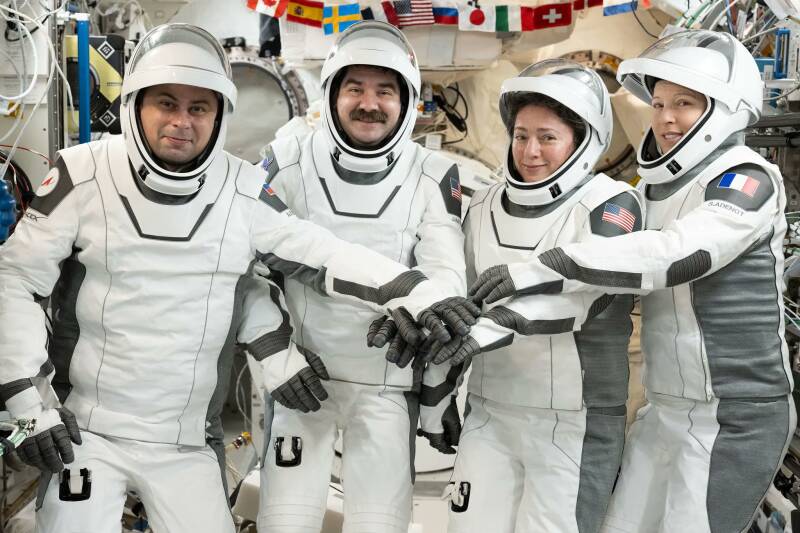
Crew-12 astronauts are preparing for their journey home. Credit NASA
NASA and SpaceX are currently targeting Wednesday, October 7, 2026, for Crew-12 to undock from the International Space Station, with splashdown planned for Thursday, October 8, off the coast of California. The return will conclude a nearly eight-month expedition that combined human spaceflight, international cooperation, scientific research and technology demonstrations aboard the orbital laboratory.
The Crew-12 team
Crew-12 consists of four astronauts representing three international space agencies:
Jessica Meir — NASA, commander
Jack Hathaway — NASA, pilot
Sophie Adenot — European Space Agency, mission specialist
Andrey Fedyaev — Roscosmos, mission specialist
The crew launched from Space Launch Complex 40 at Cape Canaveral Space Force Station, Florida, on February 13, 2026, aboard a SpaceX Falcon 9 carrying a Dragon spacecraft. Liftoff occurred at 5:15 a.m. EST.
After reaching orbit, Dragon separated from Falcon 9 and began its autonomous journey toward the International Space Station. The spacecraft docked with the station’s Harmony module on February 14, bringing the ISS crew complement to seven at the time.
Crew-12 subsequently became part of Expedition 74 and later Expedition 75, spending months conducting scientific investigations, maintaining the station and supporting the continuous human presence in low Earth orbit.
A mission built around science
Although the return marks the end of the crew's time in orbit, the scientific work carried out during Crew-12 will continue well beyond their landing.
NASA highlights a broad portfolio of research performed by the astronauts, covering human health, pharmaceuticals, biology, materials science, quantum physics and technologies needed for future exploration.
One area involved crystal-growth research. Microgravity allows scientists to study crystals under conditions that are difficult or impossible to reproduce on Earth. Crew-12 worked with experiments involving pharmaceutical compounds, including cancer-targeting treatments, with the goal of improving understanding of their structures and properties.
The crew also supported work with the station's Cold Atom Lab, where ultracold atoms can be studied for longer periods in microgravity. Such research contributes to the development of quantum technologies and improves scientists' understanding of fundamental physics.
Preparing for longer missions
Human health was another major component of Crew-12's work.
Microgravity causes significant changes to the human body, including accelerated bone loss. Crew-12 supported research into bone regeneration using scaffolds designed to mimic the structure of real bone. Researchers hope such work can benefit both astronauts on future long-duration missions and patients on Earth suffering from conditions such as osteoporosis.
Other investigations examined bone marrow, muscle and stem cells. NASA says Crew-12 research included efforts to understand how microgravity affects bone and muscle cells, as well as investigations into expanding clinical-grade stem cells in space. These experiments could eventually contribute to treatments for blood and immune-system disorders.
The astronauts also investigated how engineered cartilage develops in microgravity. The research could help scientists develop medical implants that more closely resemble natural cartilage, potentially opening new approaches for people suffering from cartilage injuries.
Space manufacturing moves forward
Crew-12 also contributed to the development of technologies that could become increasingly important as humans venture farther from Earth.
ESA astronaut Sophie Adenot worked with the Metal 3D Printer aboard the ISS. NASA says several small metal components have already been manufactured in microgravity and returned to Earth for evaluation.
The long-term objective is significant: instead of launching every replacement component from Earth, future spacecraft could potentially manufacture certain parts on demand. That capability could reduce the amount of spare hardware crews need to carry and become particularly valuable during missions far from Earth, where rapid resupply would not be possible.
Another Crew-12 investigation explored producing intravenous fluids in microgravity. Commercial IV fluids have limited shelf lives, meaning that producing them when needed could eventually reduce the amount of medical supplies required on very long missions. NASA also notes potential applications for remote or emergency situations on Earth.
A crew swap on the ISS
Crew-12's departure follows the arrival of SpaceX Crew-13, which launched on October 1 and docked with the International Space Station the same day.
Crew-13's arrival temporarily increased the station's population to 11 people, allowing the two crews to conduct a formal handover before Crew-12 departs.
On October 4, Jessica Meir formally handed command of the International Space Station to Roscosmos cosmonaut Pyotr Dubrov during the traditional change-of-command ceremony.
The transition is an important part of maintaining continuous operations aboard the ISS. Crew-13 can take over ongoing responsibilities while the departing astronauts concentrate on packing their equipment, configuring Dragon and preparing themselves for re-entry.
The journey home
NASA and SpaceX are currently targeting 8:05 a.m. EDT on Wednesday, October 7, for Crew-12's undocking.
Before departure, the astronauts will close Dragon's hatch and conduct final checks. Once Dragon separates from the station, the spacecraft will perform a series of orbital maneuvers to gradually move away from the ISS and establish the trajectory required for its return to Earth.
ESA's current schedule places undocking at approximately 12:05 GMT / 2:05 p.m. CEST on October 7. After spending just over a day in transit, the crew is scheduled to perform the deorbit burn on October 8 before entering Earth's atmosphere.
NASA currently expects the deorbit burn at approximately 10:46 a.m. EDT, followed by splashdown at around 11:34 a.m. EDT on October 8.
All of these times remain subject to change.
Dragon's critical re-entry
The final portion of the mission will be one of Dragon's most demanding phases.
After the deorbit maneuver, Dragon will enter Earth's atmosphere at extremely high speed. Its heat shield will protect the crew from the intense heating generated as the spacecraft encounters the atmosphere.
ESA notes that temperatures around the spacecraft's heat shield can reach approximately 1,600°C during atmospheric re-entry.
After surviving the peak heating phase and descending through the atmosphere, Dragon will deploy its parachutes. The spacecraft and its four occupants will then descend toward the Pacific Ocean for splashdown off the California coast.
Recovery teams will be positioned in the designated recovery area to secure the spacecraft and assist the astronauts after landing.
Weather remains a key factor
Crewed spacecraft returns are highly dependent on conditions at the recovery site.
NASA says mission managers are monitoring weather, sea conditions, spacecraft readiness and recovery-team readiness before committing to the return sequence. The exact splashdown location and timing can therefore change even after a nominal undocking date has been established.
This is particularly important for a Pacific Ocean recovery. Wind, waves, visibility and other conditions must remain within acceptable limits not only for the spacecraft's landing but also for the recovery operation that follows.
Sophie Adenot's milestone
The return also marks an important milestone for ESA astronaut Sophie Adenot.
During the mission, Adenot became the first French woman to conduct a spacewalk, completing three extravehicular activities over 14 days for a combined 19 hours and 42 minutes outside the station.
Her mission also established a major European endurance milestone. ESA reports that Adenot reached 200 consecutive days aboard the ISS on September 3, surpassing the previous European single-spaceflight record held by Luca Parmitano's Beyond mission.
Her return will therefore represent not only the conclusion of Crew-12, but also the completion of a historic mission for European human spaceflight.
Nearly eight months in space
Crew-12's expedition began on February 13 and is scheduled to conclude with splashdown on October 8.
That puts the mission at nearly eight months in orbit, during which Meir, Hathaway, Adenot and Fedyaev contributed to station science, maintenance, technology demonstrations and the continuous international operation of the ISS. NASA describes the mission as part of a broader effort to develop knowledge and technologies needed for future missions to the Moon, Mars and beyond.
Their return also demonstrates the operational rhythm that has become increasingly important to NASA's Commercial Crew Program: one Dragon crew arrives, another prepares to leave, and the International Space Station continues operating without interruption.
What comes next
Once Crew-12 splashes down, attention will shift toward the post-flight recovery of the astronauts and spacecraft, as well as the science samples and hardware returning to Earth.
For NASA and its international partners, the mission's value will continue long after the astronauts leave the Pacific Ocean. Results from Crew-12's experiments could contribute to medical research, pharmaceutical development, advanced materials, space manufacturing and strategies for keeping astronauts healthy during future deep-space missions.
For SpaceX, the return will once again demonstrate the full operational cycle of its human-spaceflight system: Falcon 9 launch, Dragon rendezvous and docking, months of crew operations aboard the ISS, autonomous undocking, atmospheric re-entry, parachute deployment and ocean recovery.
Crew-12's journey home is therefore more than the end of another ISS expedition. It represents another completed chapter in the development of routine commercial human spaceflight—and another step toward an era in which astronauts can regularly travel between Earth and increasingly ambitious destinations in space.
Current return schedule:
Oct. 7: Dragon hatch closure and undocking
Oct. 8: Deorbit burn and Pacific Ocean splashdown
Crew: Jessica Meir, Jack Hathaway, Sophie Adenot and Andrey Fedyaev
Mission duration: Nearly eight months
Splashdown: Off the California coast, Pacific Ocean
Status: Targeting return; schedule remains weather-dependent.
Add comment
Comments