

NASA and SpaceX have successfully brought the four members of Crew-12 back to Earth following an extended mission aboard the International Space Station (ISS). On Thursday, October 8, 2026, the Crew Dragon spacecraft Freedom splashed down in the Pacific Ocean off the coast of California at 11:34 a.m. Eastern Daylight Time (15:34 UTC), concluding a mission that saw the astronauts spend 237 days in space.
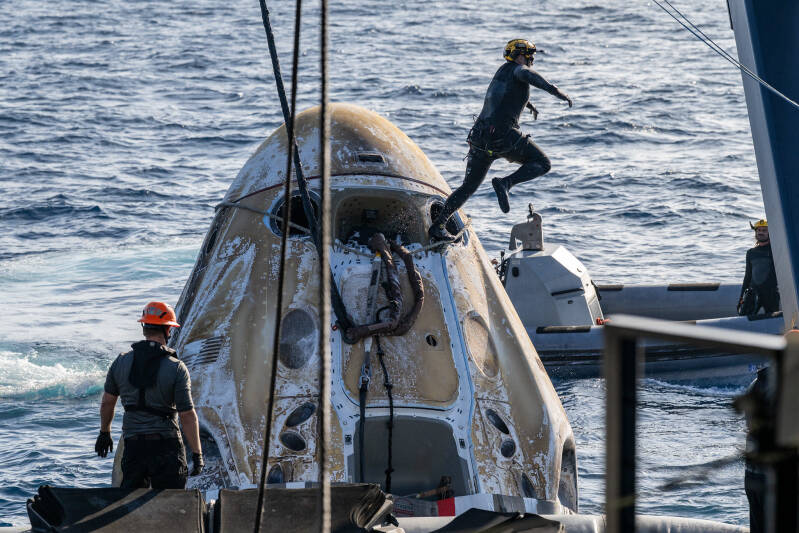
Credit NASA
The return marked the end of months of scientific research, station maintenance, spacewalks and international cooperation in low Earth orbit. It also brought home a crew whose stay aboard the orbital laboratory was extended while NASA and SpaceX prepared the next expedition to take over their duties.
Crew-12 consisted of four astronauts representing three international space agencies:
Jessica Meir — NASA: Mission commander, returning for her second spaceflight.
Jack Hathaway — NASA: Pilot, completing his first spaceflight.
Sophie Adenot — European Space Agency (ESA): Mission specialist, completing her first spaceflight.
Andrey Fedyaev — Roscosmos: Mission specialist, returning for his second spaceflight.
The crew launched aboard a SpaceX Falcon 9 rocket from Cape Canaveral Space Force Station in Florida at 5:15 a.m. EST on February 13, 2026, and docked with the ISS the following day. Their mission ultimately lasted 237 days, during which they travelled more than 100 million miles and completed over 3,792 orbits around Earth.
For the astronauts, returning to Earth meant the end of an extraordinary period of living and working in microgravity. For the space agencies involved, it marked the successful conclusion of another international expedition aboard the orbiting laboratory.
The journey home: From orbital laboratory to Pacific Ocean
The return operation began on Wednesday, October 7, when Crew-12 closed the hatch between Dragon Freedom and the International Space Station. At 8:05 a.m. EDT, the spacecraft undocked from the space-facing port of the station's Harmony module, beginning the journey back to Earth.
On Thursday, October 8, Dragon performed its deorbit burn, reducing its orbital energy and placing it on a trajectory toward the designated Pacific Ocean recovery zone off the California coast.
The deorbit burn is a critical part of every orbital return. Without it, the spacecraft would remain in orbit rather than descend toward its landing area. The manoeuvre must be precisely timed and executed to ensure the capsule enters the atmosphere along a suitable trajectory.
Atmospheric reentry and parachute deployment
Returning from orbit is one of the most demanding phases of a crewed mission. Dragon approached Earth's atmosphere at approximately 28,000 kilometres per hour, exposing its heat shield to intense heating as the spacecraft descended.
The capsule's thermal protection system was designed to withstand these extreme conditions and protect the astronauts inside. As the spacecraft slowed in the atmosphere, it transitioned from the high-speed reentry phase to the final descent sequence.
According to ESA, Dragon's drogue parachutes deployed at an altitude of approximately 5,500 metres, followed by its four main parachutes about one minute later. These parachutes further reduced the capsule's speed and stabilised its descent toward the ocean.
At 11:34 a.m. EDT (15:34 UTC) on October 8, Dragon Freedom completed its descent and splashed down safely in the Pacific Ocean off the coast of Los Angeles, California. The successful landing confirmed the completion of Crew-12's return flight.
Recovery teams retrieve Dragon Freedom
Splashdown was not the final step of the operation. Once Dragon reached the water, SpaceX's recovery teams moved quickly to secure the spacecraft and begin the process of bringing the astronauts safely aboard the recovery vessel.
Fast boats approached the capsule and carried out initial safety checks before the recovery ship Shannon moved into position. The team then prepared to hoist Dragon onto the vessel's main deck.
After the capsule was secured, recovery personnel opened the side hatch and assisted the astronauts as they exited the spacecraft. The crew underwent initial medical assessments before beginning the next stage of their journey back to shore and NASA's Johnson Space Center in Houston.
The recovery process is an essential part of human spaceflight. Even after a successful landing, crews must account for the capsule's condition, the surrounding sea conditions and the physical effects of spending months in microgravity.
Seven spacewalks and months of scientific research
Crew-12's return also brought an end to an extensive programme of scientific investigations, maintenance activities and work outside the International Space Station.
During their mission, the astronauts contributed hundreds of hours to scientific research intended to advance human space exploration and improve life on Earth. Their investigations included:
●Stem cell production: Testing methods that could support cell-based therapies.
●On-demand intravenous fluids: Demonstrating technology that could help future crews produce essential medical supplies during long-duration missions.
●Heart and respiratory health: Studying how bacteria associated with pneumonia may contribute to long-term heart damage.
●Nutrition and circulation: Investigating nutritional needs and how physical characteristics influence blood flow during spaceflight.
These studies are particularly important as space agencies prepare for longer missions beyond low Earth orbit. Understanding how the human body responds to microgravity, and how medical supplies can be produced or managed in space, will be essential for future exploration of the Moon and Mars.
The mission also featured significant extravehicular activity, commonly known as spacewalks. NASA astronaut Jessica Meir completed four spacewalks during Crew-12, bringing her career total to seven. ESA astronaut Sophie Adenot completed three spacewalks, becoming the first French woman to venture outside the International Space Station.
Crew-12's return follows the arrival of Crew-13
Crew-12's departure was part of a carefully coordinated handover aboard the International Space Station.
SpaceX's Crew-13 mission arrived at the station on October 1, bringing four new crew members to the orbital laboratory. The new expedition reached the ISS in approximately seven hours and 55 minutes after launch, setting a record for the quickest trip to the station by an American spacecraft at the time.
The arrival of Crew-13 allowed the station's operations to continue while Crew-12 prepared for its return. Such crew rotations are essential for maintaining a continuous human presence in orbit, ensuring that scientific investigations, equipment maintenance and station operations continue across successive expeditions.
With Crew-12 now back on Earth, the newly arrived crew can continue the work aboard the station, including research that supports future human exploration.
The successful handover also demonstrates the role of commercial crew transportation in NASA's long-term strategy. SpaceX's Dragon spacecraft provides a reusable means of transporting astronauts to and from the ISS, while international partnerships ensure that the station remains a shared platform for scientific research.
Postflight recovery begins on Earth
Although the astronauts have returned safely, the physical effects of their extended stay in space do not disappear immediately.
Living in microgravity changes how the body responds to gravity, including its balance mechanisms, muscle use and cardiovascular function. Following a 237-day mission, the astronauts will undergo medical evaluations and a postflight conditioning programme designed to help them readjust to life on Earth.
The process includes monitoring their health, rebuilding physical strength and helping them regain normal balance and mobility. The duration and intensity of rehabilitation can vary depending on each astronaut's condition and individual recovery needs.
The astronauts will also have an opportunity to reunite with their families and return to everyday life after more than seven months away from Earth.
NASA announced that Meir, Hathaway and Fedyaev are scheduled to discuss their mission during a news conference at Johnson Space Center on October 15. Adenot will return to Europe and will not participate in that briefing.
Why the Crew-12 return matters
Crew-12's successful return represents more than the safe landing of four astronauts. It demonstrates the complete cycle of a modern crewed spaceflight mission: launch, orbital operations, scientific research, spacecraft departure, atmospheric reentry, parachute-assisted descent and recovery.
The mission's research will contribute to efforts to make future spaceflight safer and more sustainable. Its spacewalk achievements also highlight the continuing importance of maintaining and operating the International Space Station as a testbed for technologies and procedures needed for exploration farther from Earth.
At the same time, the return reinforces the importance of reliable commercial transportation systems. SpaceX's Dragon spacecraft and recovery infrastructure form part of the operational capability needed to sustain a continuous human presence in orbit.
For NASA, ESA, Roscosmos and SpaceX, the successful splashdown marks the completion of a demanding mission and the return of a crew whose work contributed to the scientific and operational objectives of the International Space Station.
Crew-12 is home. After 237 days in space, more than 3,792 orbits and over 100 million miles travelled, Jessica Meir, Jack Hathaway, Sophie Adenot and Andrey Fedyaev have completed their journey and returned safely to Earth. Their mission leaves behind valuable research, notable spacewalk achievements and another successful chapter in international cooperation in human spaceflight.
Add comment
Comments