

A Starlink satellite launch update is never just about another batch of spacecraft reaching low Earth orbit. It is a live readout on SpaceX launch cadence, Falcon 9 fleet health, booster turnaround, and the company’s wider push to turn orbital access into a routine service rather than a rare event. That is why each new Starlink mission attracts more attention than its familiar flight profile might suggest. On the surface, these launches can look almost interchangeable: a Falcon 9 lifts off from Florida or California, deploys another stack of satellites, and lands its first stage downrange or back at the launch site. But the operational story beneath that pattern is where the real movement is happening.
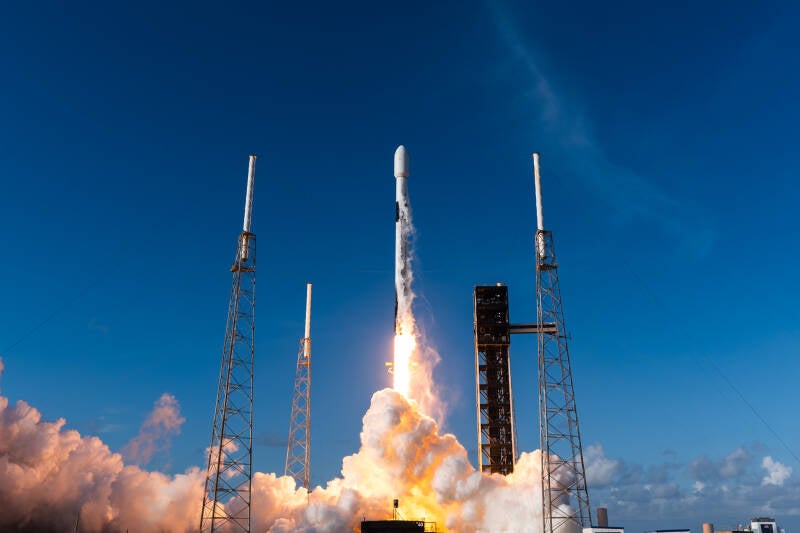
Credit SpaceX
Starlink satellite launch update: the bigger picture
The latest Starlink activity continues to show one of the clearest trends in modern spaceflight - launch is becoming industrialised. SpaceX is not treating Starlink as an occasional flagship mission. It is using the constellation as a standing demand signal, one that keeps pads active, boosters flying, and recovery teams in constant rotation.
For readers tracking the sector closely, that matters well beyond broadband. Starlink launches are effectively a stress test of the commercial launch model. If SpaceX can keep sending satellites up at high tempo while recovering and reflighting boosters with minimal disruption, it strengthens the case that reusable rockets are no longer an experiment. They are now infrastructure.
There is also a second layer to any current Starlink launch update: not all launches carry the same strategic weight. Some are straightforward replenishment flights. Others support expansion into new orbital shells, regional coverage improvements, or capability upgrades tied to newer satellite variants. A launch may look routine on the webcast timeline, yet still reflect a meaningful shift in network build-out.
What recent Starlink launches tell us
The strongest signal from recent Starlink missions is sustained cadence. SpaceX has kept Falcon 9 in a rhythm that would have looked improbable even a few years ago, with flights often separated by only days. That pace is significant because cadence, more than one-off spectacle, is what determines whether launch providers can support large constellations, government payload demand, and future deep-space ambitions all at once.
Booster reuse remains central to that story. Every successful landing after a Starlink mission feeds directly into the company’s turnaround model. A reused first stage is no longer novelty value for launch fans, even if it still produces the loudest applause. It is an economic and operational metric. The key question is less whether the stage lands and more how quickly that vehicle, or one like it, can be prepared for another mission.
Payload deployment is the other area worth watching. Starlink missions have become a window into SpaceX’s confidence in satellite production and dispenser operations. A clean separation sequence, followed by confirmation that the satellites are on track for orbit-raising, points to a mature deployment system. Any interruption, delay, or altered mission profile would stand out immediately because the baseline has become so consistent.
That consistency does not mean every launch is identical. Differences in inclination, launch site, landing plan, and satellite generation all shape the mission. Flights from Vandenberg, for example, often support different orbital needs from those lifting off in Florida. That distinction matters to readers trying to understand not just when a launch happens, but what part of the network it is intended to serve.
Why Falcon 9 cadence matters so much
A high-volume Starlink campaign is also a Falcon 9 campaign. Every launch provides another data point on reliability, maintenance cycles, and fleet flexibility. If one booster is unavailable, SpaceX increasingly appears able to swap vehicles, adjust schedules, and keep the manifest moving.
That flexibility is becoming one of the company’s biggest competitive advantages. In traditional launch models, a delay to one vehicle or payload could ripple across the entire calendar. SpaceX still experiences scrubs and schedule changes, as every launch operator does, but its depth of hardware and recovery infrastructure gives it more room to absorb disruption.
There is a trade-off, though. A packed launch calendar raises expectations. When a Starlink mission slips, observers now ask whether the cause is weather, pad availability, range constraints, booster processing, or payload readiness. The bar has shifted. Routine launch service creates a new kind of scrutiny, because anything that breaks the rhythm becomes a story in itself.
Starlink satellite launch update and network growth
For the Starlink network, each launch adds capacity, redundancy, or replacement assets, but the value depends on where those satellites are headed and which generation is flying. This is where a simple launch count can be misleading.
A mission carrying more capable satellites can matter more than several earlier launches with older hardware. SpaceX has steadily iterated on Starlink spacecraft design, balancing mass, on-board systems, and compatibility with Falcon 9 performance. As newer versions enter service, the constellation’s usefulness is not defined only by quantity. Quality matters as well - especially for throughput, latency management, and direct-to-cell ambitions.
That is one reason current launch watchers pay attention to which vehicle is doing the work. Falcon 9 remains the backbone of Starlink deployment, but the long-term architecture clearly points towards Starship taking on a much larger role if and when it reaches operational readiness. Until then, every Falcon 9 Starlink mission is doing double duty: expanding the network now while buying time for the next-generation launch system to mature.
What can change between one mission and the next
Even in a well-drilled operation, launch updates can shift quickly. Weather remains an obvious factor, especially for both launch commit criteria and recovery conditions in the booster landing zone. Upper-level winds, sea state around the droneship, and local conditions at the pad can all reshape the timeline.
Then there are the quieter constraints. Range scheduling can become a pressure point when multiple operators are active. Technical inspections may extend processing by hours or days. Satellite readiness can alter the mission sequence before the public sees any formal update. That is the reality of high-frequency launch operations: the outside view may look smooth, but the internal schedule is constantly being refined.
For industry followers, these details matter because they show how resilient the launch system really is. A single scrub is not especially revealing. Rapid recovery from a scrub is. If SpaceX can recycle teams, hardware, and pad support without a long knock-on effect, it reinforces the idea that launch cadence is now driven by process discipline rather than one-off heroics.
What to watch in the next phase
The most useful way to read the next Starlink satellite launch update is to look beyond the lift-off time. Watch the spacing between missions. Watch whether booster assignments suggest smooth fleet rotation. Watch for any signs that newer satellite configurations are becoming standard rather than occasional.
It is also worth tracking how Starlink shares manifest space with other priorities. SpaceX is balancing commercial, civil, and national security obligations alongside its own constellation needs. If Starlink flights continue at pace without crowding out those commitments, that says a great deal about the maturity of the company’s launch machine.
For UK readers and the wider global audience, there is a practical angle too. Starlink launches are no longer remote spectacles disconnected from daily life. They feed a network with real consumer, maritime, aviation, and emergency-response applications. The launch itself lasts minutes, but its implications reach into communications infrastructure, market competition, and how quickly private industry can scale orbital systems.
That is why these updates remain worth following, even when the mission patch changes and the flight profile barely does. In commercial spaceflight, repetition is not dullness. Repetition is proof that a system is working - and every successful Starlink launch adds another piece of evidence that routine orbital operations are arriving faster than much of the industry expected.
The next mission will still bring the usual questions on timing, weather and booster history, but the bigger story is now clear: SpaceX has turned Starlink launches into a measure of industrial pace, and that makes every update more consequential than it first appears.
Add comment
Comments