

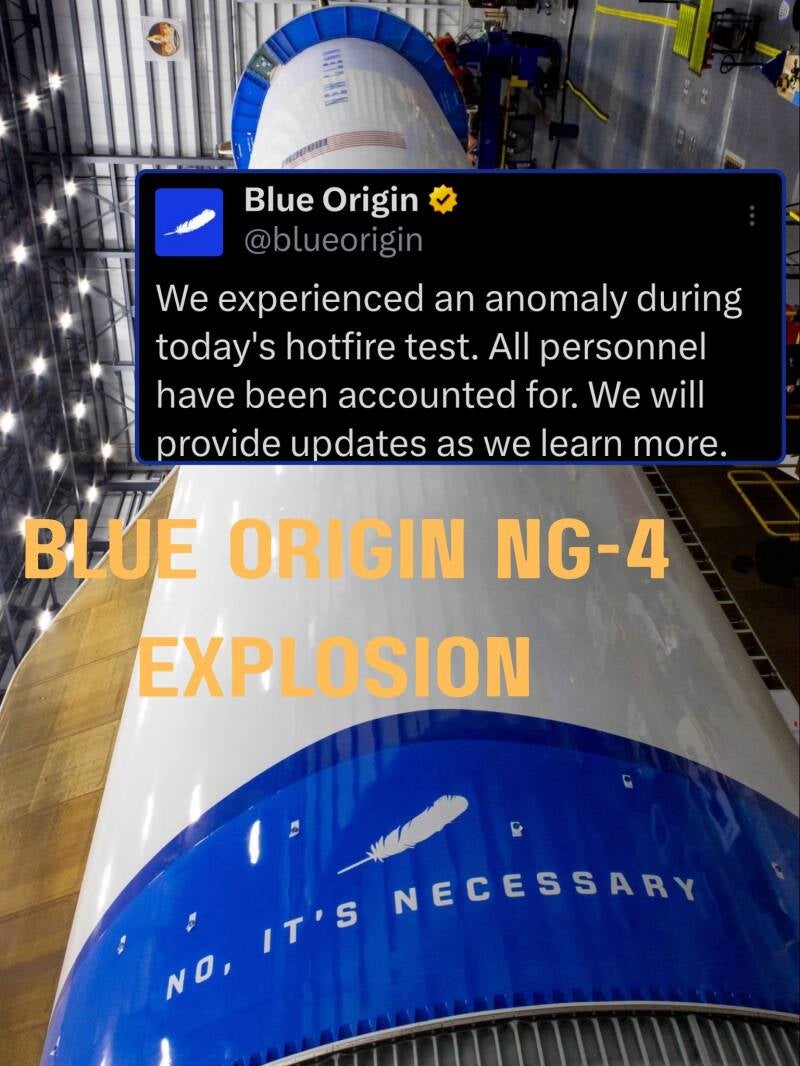
Blue Origin’s New Glenn rocket suffered a major anomaly last night during a static‑fire test at Cape Canaveral, triggering a fiery explosion that now raises serious questions for two major programs: NASA’s Artemis program and Amazon’s upcoming LEO satellite launch. The incident occurred around 9 p.m. ET during a planned hot‑fire test of the New Glenn booster ahead of its fourth mission, which was scheduled to carry 48 Amazon LEO broadband satellites. All personnel were confirmed safe, but the explosion destroyed the test vehicle and may have damaged Launch Complex 36, the only pad capable of launching New Glenn.
What Happened: The Anomaly
Blue Origin confirmed that the rocket “experienced an anomaly during today’s hotfire test”, resulting in one of the largest static‑fire explosions in U.S. commercial spaceflight history.
Jeff Bezos stated that it was “too early to know the root cause,” but emphasized that the company would rebuild and return to flight.
NASA Administrator Jared Isaacman acknowledged the severity of the event, noting that spaceflight is unforgiving and that NASA will work with Blue Origin to assess mission impacts.
Consequences for the Artemis Program
The New Glenn rocket is a critical component of NASA’s Artemis architecture:
-
It is scheduled to launch Blue Moon Mark 1 and Mark 2 lunar landers, which will deliver cargo and eventually crew to the lunar surface.
-
Artemis III’s Earth‑orbit test flight relies on New Glenn to place the Blue Moon MK2 lander into orbit for docking practice with NASA astronauts.
Potential Impacts
-
Delays are highly likely. New Glenn will almost certainly be grounded pending investigation.
-
Launch pad damage could extend downtime, since LC‑36 is the only New Glenn‑capable pad.
-
Artemis timelines—already tight—may face additional pressure, especially for the 2027–2028 lander integration milestones.
While NASA has not yet issued a revised schedule, the agency has confirmed it will “assess near‑term mission impacts.”
Consequences for Amazon’s LEO Satellite Launch
The failed booster was being prepared for the Amazon LEO (Project Kuiper‑like) mission, intended to deploy 48 satellites to expand Amazon’s broadband constellation.
Expected Effects
-
Immediate delay of the next Amazon LEO launch, originally planned for early June.
-
Amazon must now wait for New Glenn to return to flight—or shift payloads to another launch provider, which is unlikely in the short term due to vehicle compatibility.
-
The setback may slow Amazon’s competition with Starlink, which continues rapid deployment.
Given that New Glenn had just been cleared to fly again after a previous second‑stage anomaly, this new failure compounds schedule pressure.
Broader Implications
-
Blue Origin’s 2026 launch cadence—planned for up to 12 missions—will almost certainly be reduced.
-
National security missions that were expected to fly on New Glenn may need reassignment.
-
The explosion underscores the difficulty of developing heavy‑lift rockets capable of competing with SpaceX’s Falcon Heavy and Starship.
What Happens Next
Investigators from Blue Origin, NASA, the Space Force, and the FAA are now analyzing telemetry and debris to determine the root cause.
The timeline for recovery depends on:
-
Severity of pad damage
-
Root‑cause complexity
-
Required redesigns or manufacturing changes
-
FAA recertification process
Given historical precedents (e.g., SpaceX’s 2016 pad explosion), a months‑long delay is a reasonable expectation—though this remains an inference based on similar events, not yet confirmed by Blue Origin.
Add comment
Comments