

A Falcon 9 launch can move from pencilled in to scrubbed to airborne in the space of a day, which is exactly why the Falcon 9 launch schedule draws so much attention. For regular launch followers, the date itself is only part of the story. The real value is understanding what is firm, what is provisional, and what each mission says about SpaceX's current operating tempo.
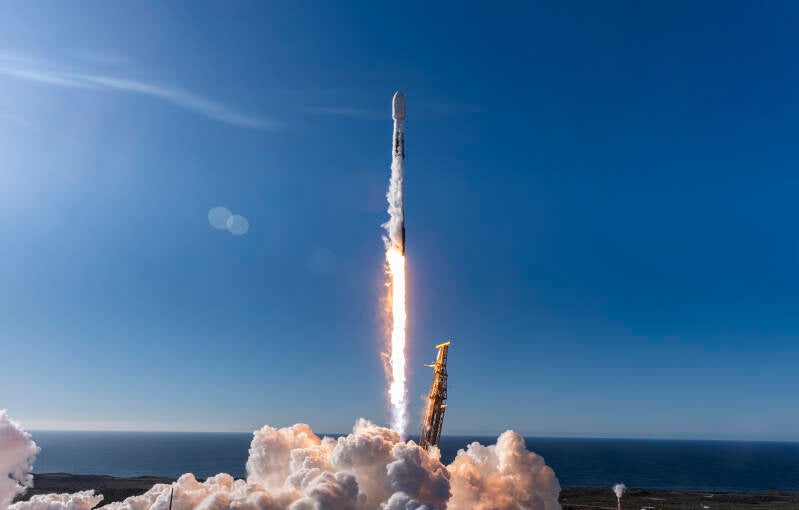
Credit SpaceX
Why the Falcon 9 launch schedule changes so often
On paper, a launch schedule looks simple: rocket, payload, pad, time. In practice, Falcon 9 missions sit inside a tightly managed chain of range availability, weather, booster readiness, payload processing and airspace or maritime clearance. A launch can be technically ready and still slip because the Eastern or Western Range is busy, upper-level winds are poor, or a previous mission consumed turnaround time at the pad.
That matters because SpaceX now flies at a cadence that would have looked unrealistic only a few years ago. With dozens of missions stacked across Starlink deployments, commercial satellite launches, rideshares and government flights, the schedule is less a fixed calendar than a live operations board. Readers tracking the next mission need to think in windows, not promises.
The company has also normalised rapid replanning. If a booster is reassigned, if static fire timing changes, or if a payload customer needs extra checks, the public-facing launch date can move with very little warning. That is not necessarily a sign of trouble. Often, it is the by-product of a launch system designed to keep flying rather than wait for ideal neatness.
How to read a Falcon 9 launch schedule properly
The most common mistake is treating every published date as equally solid. They are not. Some missions are attached to a broad target month, others to a specific day, and only the closest-in launches tend to have a reliable opening time. Even then, the confidence level changes as the countdown approaches.
A useful way to read the schedule is by asking four questions. First, how close is the mission to flight? A launch set for next week is inherently more credible than one listed for next month. Second, what kind of payload is involved? Government missions often carry stricter processing and range requirements, while Starlink flights can be more operationally flexible. Third, is the launch pad already turning around from a previous flight? And fourth, is the assigned booster known and available?
Those details tell you far more than a single date on a graphic. For experienced followers, the mission profile is often the best clue to whether a published target will hold.
Starlink missions move differently
If you watch the schedule closely, Starlink flights often behave differently from customer missions. They are still operationally demanding, but SpaceX controls the payload side of the equation, which can make replanning easier. A Starlink launch may shift by a day or two and still remain within a broader deployment strategy.
That flexibility is one reason Falcon 9 can maintain such a high annual flight rate. Internal missions give SpaceX room to keep boosters active, preserve rhythm at the pads and fill gaps between commercial and government launches. When readers see several Starlink flights clustered close together, it usually signals strong confidence in vehicle flow and pad readiness.
Customer and national security flights carry different pressure
Commercial communications satellites, crewed flights and national security missions tend to attract more scrutiny because the margin for disruption is lower. These launches often involve more layered reviews, tighter mission assurance demands or narrower orbital constraints. In those cases, even a small issue in fuelling, weather or payload checks can send the date sideways.
That does not make the schedule unreliable. It simply means different missions have different tolerances. A busy Falcon 9 manifest includes both routine repetition and high-stakes exceptions, and readers should expect the schedule to reflect that mix.
What the current cadence says about SpaceX
The biggest story behind any Falcon 9 launch schedule is not one launch but the accumulation of launches. Cadence has become a strategic signal. Every successful turnaround strengthens SpaceX's position not just as a launch provider, but as an operator running industrial-scale access to orbit.
This is where the schedule becomes more than a list of dates. A dense manifest shows confidence in booster reuse, pad refurbishment speed, fairing recovery and mission integration. When Falcon 9 flies repeatedly from Florida and California with only short gaps, it demonstrates something the wider sector still struggles to match: a launch system behaving less like a rare event machine and more like transport infrastructure.
That has consequences across the industry. Satellite operators can plan around more frequent access. Competitors face a benchmark that keeps rising. Regulators and range operators are pushed to support faster activity. Even delays, in that context, can tell a positive story. A slip of 24 or 48 hours inside a packed manifest is very different from a programme that flies only occasionally.
Why exact dates matter less than launch windows
For many readers, especially those planning to watch live, the question is simple: when is the next Falcon 9 launch? That is fair, but exact dates can be misleading if they are stripped of context. Launch providers usually work within windows, and those windows may be tied to orbital mechanics, daylight conditions, rendezvous requirements or recovery-zone constraints.
A mission to low Earth orbit may have more flexibility than one targeting a very specific injection profile. A drone ship positioned downrange also adds another operational layer. Sea state, vessel readiness and recovery timing can influence the broader flow around the mission, even if the rocket itself looks ready.
This is why the best schedule reporting does not just post a date and move on. It explains whether a mission is aiming for a narrow instant, a multi-hour window or a day with backup opportunities. That context helps readers distinguish a genuine schedule break from a normal countdown adjustment.
Tracking the Falcon 9 launch schedule without overreacting
There is a temptation in launch coverage to treat every schedule movement as dramatic. Sometimes it is. More often, it is routine. A slip from Tuesday to Wednesday is usually an operational adjustment, not a programme-level issue. A mission dropping out of a known slot entirely deserves more attention, especially if it affects downstream launches.
For readers following the manifest week by week, pattern recognition helps. If multiple launches bunch up after several delays, SpaceX may be working through pad congestion or range conflicts. If one mission keeps moving while others continue to fly, the issue may sit with the payload rather than the rocket fleet. If a booster appears on another assignment, that can reshape expectations quickly.
This is where specialist reporting earns its keep. SpaceX FrontPage readers are usually not looking for a vague sense that something is happening soon. They want a practical understanding of mission status, likely timing and what a delay actually means. The schedule is most useful when it is treated as live operational intelligence rather than static diary copy.
What to expect from the schedule this year
If current trends hold, the Falcon 9 launch schedule will remain crowded, flexible and occasionally messy in the best industrial sense of the word. More flights mean more opportunities for quick turnaround, but they also mean more chances for minor knock-on delays. That trade-off is now part of the Falcon 9 era.
Readers should also expect launch tempo to stay tied to broader strategic priorities. Starlink remains a major driver of cadence, but crew missions, commercial payloads and government contracts will continue to shape how visible and predictable the public schedule appears. The more varied the manifest, the more often the calendar will need adjusting.
That does not weaken confidence in the rocket. If anything, it shows how much demand is being routed through one vehicle family. Falcon 9 is no longer notable simply because it launches often. It is notable because frequent launches have become normal, and the schedule now reflects the pressures of scale as much as the thrill of liftoff.
The smartest way to follow the next mission is to stay flexible, watch for confirmation close to launch day, and pay attention to the operational clues around the date rather than the date alone. In modern launch coverage, timing is never just a number on a page.
Add comment
Comments