

In a significant milestone for U.S. military space operations, the U.S. Space Force successfully launched the final satellite in its Global Positioning System (GPS) III series early Tuesday morning. The mission lifted off aboard a Falcon 9 rocket operated by SpaceX, signaling the conclusion of a major modernization phase for the GPS constellation. The rocket launched at 2:53:25 a.m. EDT (0653:25 UTC) from Space Launch Complex 40 at Cape Canaveral Space Force Station, after a 24-hour delay caused by unfavorable weather conditions in the booster recovery zone.
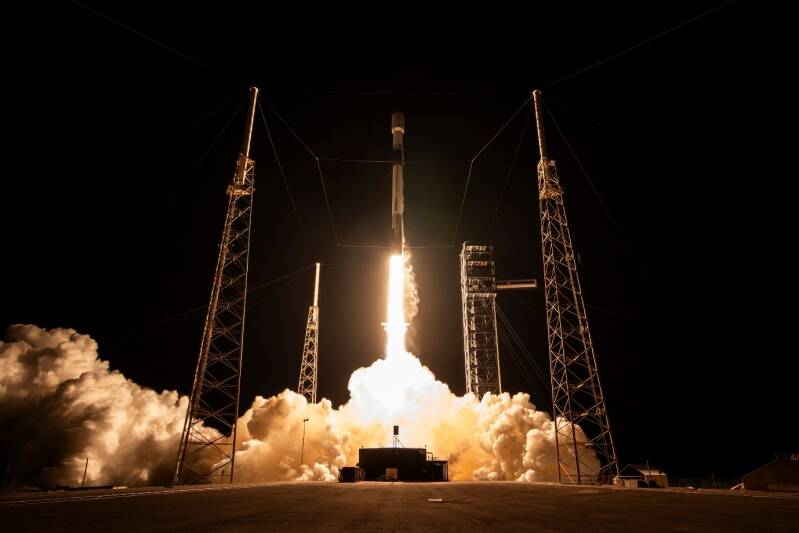
Credit: SpaceX
The satellite, officially designated Space Vehicle 10 (SV10), is also named “Hedy Lamarr” in honor of Hedy Lamarr. Her pioneering work on frequency-hopping technology laid the groundwork for modern wireless communications, including GPS, Wi-Fi, and Bluetooth.
This launch marks the eighth and final satellite in the GPS III block, a series that has significantly improved navigation accuracy, signal strength, and resistance to interference compared to earlier generations.
Col. Stephen Hobbs, commander of Mission Delta 31, described the moment as both a conclusion and a beginning. He emphasized that while the GPS III program is wrapping up, it sets the stage for the next-generation GPS IIIF satellites, which will bring even more advanced capabilities to both military and civilian users worldwide.
The mission showcased SpaceX’s hallmark reusability. The Falcon 9 first-stage booster, designated B1095, flew for the seventh time, having previously supported six Starlink missions. Approximately 8.5 minutes after liftoff, the booster successfully landed on the drone ship Just Read the Instructions stationed in the Atlantic Ocean.
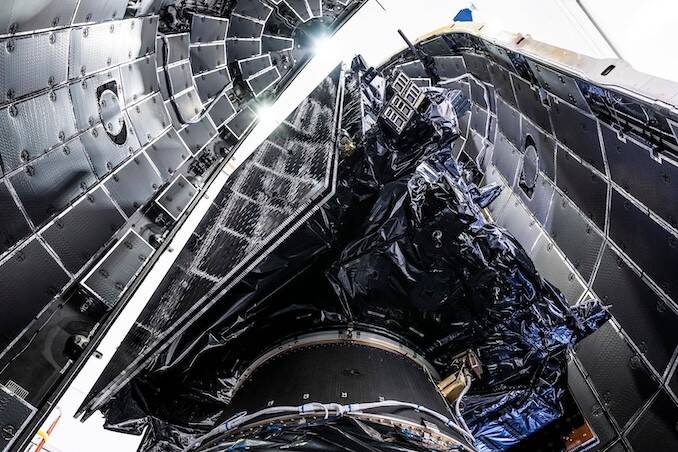
The GPS III Space Vehicle 10 satellite, named ‘Hedy Lamar’, is photographed during the process of it being encapsulated within SpaceX Falcon 9 payload fairings. Image: SpaceX
The payload fairing halves also demonstrated reuse, with one half flying for the second time and the other for the third. Notably, one of the fairing components had previously supported the GPS III-9 mission earlier this year.
Anne Mason, director of SpaceX’s National Security Space Launch division, highlighted that reusing proven hardware enhances mission assurance and efficiency for both SpaceX and the Space Force.
Strategic Flexibility in Launch Contracts
This mission also underscores growing flexibility within the U.S. national security launch program. Originally assigned to United Launch Alliance (ULA), the satellite was reassigned to SpaceX due to delays in ULA’s Vulcan rocket development.
In total, this marks the fourth GPS satellite transferred from ULA to SpaceX under the National Security Space Launch (NSSL) Phase 2 contract. ULA’s Vulcan rocket only received certification for such missions in 2025 and has since faced technical challenges, including an issue with a solid rocket booster during a recent flight.
Officials noted that cooperation between SpaceX and ULA has improved over time, allowing smoother mission swaps and ensuring timely deployment of critical national security assets. As part of this arrangement, ULA will launch the USSF-70 mission aboard a Vulcan rocket in 2028, a payload originally slated for SpaceX’s Falcon Heavy.
Once deployed roughly 90 minutes after launch, the SV10 satellite will spend about 10 days raising its orbit to its operational position in medium Earth orbit. It will then undergo several days of testing before being handed over for operational use.
The satellite joins a constellation of 38 GPS spacecraft, 32 of which are currently active, enhancing the system’s resilience and reliability.
SV10 also carries experimental technologies that will shape future systems, including a laser-based optical cross-link communication system and an advanced digital atomic clock for improved timing precision. These innovations are expected to play a key role in the upcoming GPS IIIF generation.
Lockheed Martin executive Fang Qian noted that the deployment of SV10 not only strengthens current GPS capabilities but also lays the foundation for a more resilient and advanced navigation system in the years ahead.
With the GPS III program now complete, attention turns to the next phase of evolution. The forthcoming GPS IIIF satellites are expected to deliver enhanced anti-jamming capabilities, improved accuracy, and greater interoperability with allied systems.
Tuesday’s launch represents more than just another satellite deployment—it marks the end of a transformative chapter and the beginning of a more advanced era for global navigation technology.
Add comment
Comments