

SpaceX successfully launched its most powerful operational rocket, the Falcon Heavy, on Wednesday, sending a next-generation communications satellite into orbit and marking a significant milestone for global connectivity. The towering 70-meter rocket lifted off at 10:13 a.m. EDT (1413 UTC) from Launch Complex 39A at Cape Canaveral Space Force Station. Powered by 27 Merlin engines generating approximately 5 million pounds of thrust, the rocket soared skyward on its 12th mission since its debut in 2018.
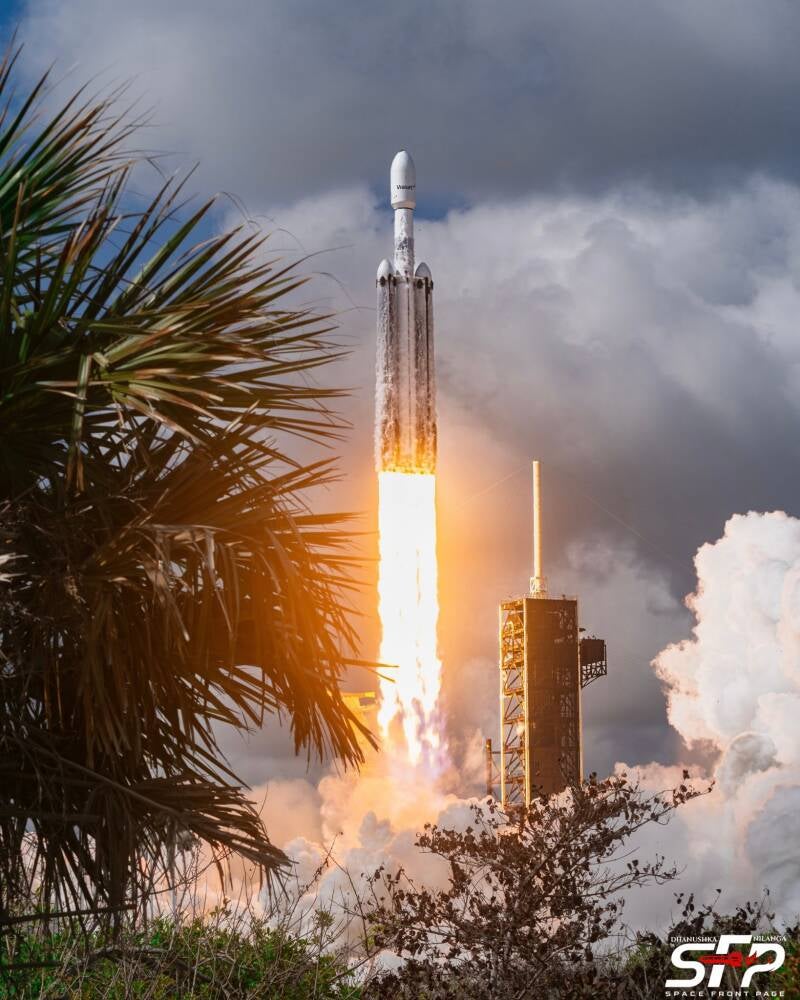
SpaceX Falcon Heavy launches for the 12th time since its 2018 debut, carrying the third satellite needed to complete the ViaSat-3 broadband constellation
Moments after liftoff, the rocket’s two side boosters—designated B1072 and B1075—separated roughly two and a half minutes into flight. After executing precise boost-back burns lasting over a minute, both boosters returned to Earth, landing nearly simultaneously at designated pads within the Cape. The mission marked the first use of SpaceX’s newest landing facility at Space Launch Complex 40 for a Falcon Heavy booster recovery.
Meanwhile, the central core (B1098) continued its ascent for another 90 seconds before separating from the upper stage. As is typical for Falcon Heavy missions, the center core was not recovered.
The rocket’s upper stage then began a complex series of three engine burns over a five-hour period to deliver its payload, the ViaSat-3 F3 satellite, into a geosynchronous transfer orbit. To endure the long coast phase between burns, the stage is equipped with enhanced thermal protection to prevent its rocket-grade kerosene fuel from freezing in space.
The satellite—built by Viasat—is the third and final addition to the ViaSat-3 constellation, a trio of high-capacity satellites designed to deliver global broadband coverage. The first of the series, ViaSat-3 Americas, was also launched aboard a Falcon Heavy rocket in 2023.
Dave Abrahamian, Viasat’s Vice President of Satellite Systems, described the launch as the culmination of more than a decade of work.
“It’s kind of the end of an era,” Abrahamian said in a prelaunch interview. “We’ve been working this program for over 10 years now. It’s a completely different world compared to when we started.”
Following deployment, the satellite will undergo approximately two months of orbit-raising maneuvers before reaching its final orbital slot at 155.58 degrees East longitude above the equator. From there, it will provide coverage across the Asia-Pacific region, significantly expanding Viasat’s network capacity by more than one terabit per second.
The satellite’s advanced phased-array technology allows operators to dynamically allocate bandwidth where it is needed most—an evolution from traditional satellites with fixed coverage beams.
“We can form beams wherever demand exists,” Abrahamian explained. “It gives us the flexibility to shift capacity in real time, ensuring we’re meeting customer needs without the limitations of older systems.”
The added capacity is expected to benefit airline and broadband customers across the Asia-Pacific region, where demand for high-speed connectivity continues to surge.
With the successful deployment of ViaSat-3 F3, both SpaceX and Viasat have achieved a major step forward in expanding global communications infrastructure—ushering in a more flexible and high-capacity era of satellite internet.
Add comment
Comments