

A discarded upper stage from a SpaceX Falcon 9 rocket is on course to collide with the Moon’s near side in early August, in what experts describe as a rare and scientifically notable—though harmless—event. The rocket stage, left over from a January 2025 launch that carried two commercial lunar landers, has been drifting through a highly elliptical orbit around Earth for more than a year. That orbit periodically carried it beyond the Moon before gravitational interactions gradually altered its trajectory. Astronomers now project that journey will end with an impact on Aug. 5.
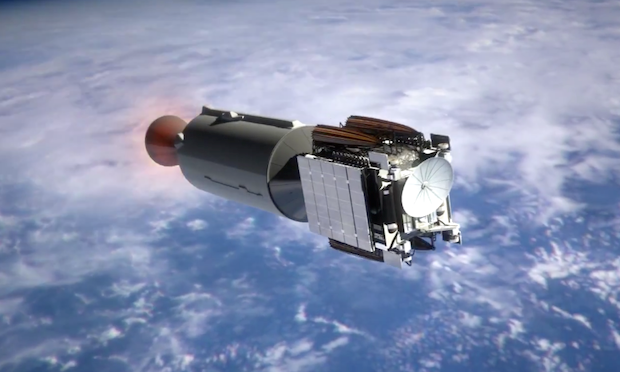
DSCOVR on its Falcon 9 upper stage (Representational image) Credit: ESA
According to independent orbital analyst Bill Gray, the object—designated 2025-010D—is expected to strike in or near the Einstein crater along the Moon’s western limb at approximately 2:44 a.m. Eastern Time (0644 UTC). The prediction is based on more than a thousand observations gathered by asteroid surveys and telescopes since its launch.
Gray noted that while the stage had made several close passes by both Earth and the Moon, none initially suggested a collision course. “As of late February, we had accumulated over a thousand observations,” he wrote, adding that improved tracking has steadily refined the impact forecast.
The stage originally launched aboard a Falcon 9 rocket carrying Firefly Aerospace’s Blue Ghost Mission 1 and ispace’s Hakuto-R Resilience lander. While Blue Ghost successfully reached the lunar surface, the rocket’s upper stage remained adrift in deep space.
Weighing roughly 4,000 kilograms and measuring nearly 14 meters in length, the object is expected to hit the Moon at a speed of about 2.43 kilometers per second—roughly 8,700 kilometers per hour. Despite the dramatic velocity, the impact poses no threat to Earth and is unlikely to be visible, as it is expected to occur on a sunlit portion of the lunar surface.
Tracking such objects involves a combination of radar and optical systems. The United States Space Force maintains a catalog of orbital debris and spacecraft, using radar for near-Earth tracking. However, for distant objects like this stage, astronomers rely more heavily on telescopic observations.
Additional tracking data has been provided by Swiss firm s2a systems, which observed the tumbling motion of the stage as it moved across the star field—an indication of its uncontrolled state.
While current calculations are considered reliable, Gray cautioned that subtle forces such as solar radiation pressure—tiny but persistent pushes from sunlight—can gradually alter an object’s path over time. Even so, he expects the impact location to be determined with high precision as the date approaches.
Unintentional impacts of human-made objects on the Moon are extremely rare. The upcoming event follows a similar incident in 2022, when a Chinese Long March 3B upper stage struck the lunar far side, leaving behind a distinctive double crater. That earlier impact also drew attention after initial confusion over the object’s origin.
Unlike that case, the trajectory of this Falcon 9 stage has been continuously tracked since launch, giving scientists a clearer picture of its final destination.
Though invisible to most observers on Earth, the impact offers a unique opportunity for researchers to study how artificial objects interact with the lunar surface—adding another small chapter to humanity’s growing footprint beyond our planet.
Add comment
Comments