

NASA is preparing for its next human spaceflight mission under the Commercial Crew Program, announcing that the SpaceX Crew-13 launch is now targeted for no earlier than mid-September. The revised timeline, moved up from November, is part of the agency’s effort to increase the frequency of U.S. crew rotation missions to the International Space Station (ISS) and maintain a steady human presence in orbit.
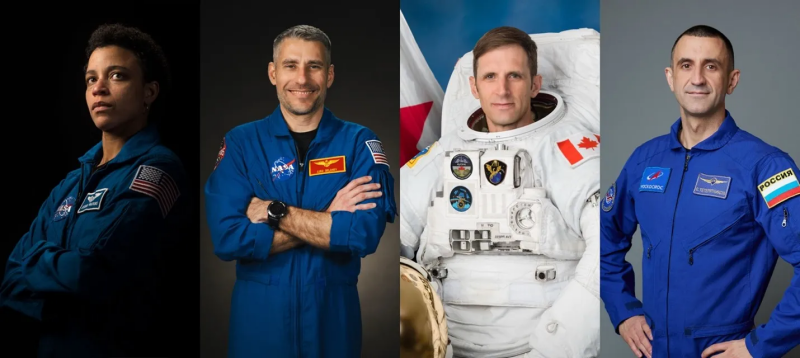
From left to right, NASA astronauts Jessica Watkins and Luke Delaney, CSA (Canadian Space Agency) astronaut Joshua Kutryk, and Roscosmos cosmonaut Sergey Teteryatnikov. Credit: NASA
The Crew-13 mission will carry four astronauts representing three international space agencies. Jessica Watkins will serve as spacecraft commander, with Luke Delaney as pilot. They will be joined by Joshua Kutryk of the Canadian Space Agency and Sergey Teteryatnikov of Roscosmos, both serving as mission specialists. Upon arrival, the crew will join Expedition 75 aboard the International Space Station, continuing more than two decades of continuous human habitation in space.
This mission marks the 13th operational crew rotation flight conducted by SpaceX for NASA, highlighting the growing maturity of the Commercial Crew Program. During their stay, the astronauts will carry out a wide range of scientific investigations and technology demonstrations designed to support future deep-space exploration. The research conducted aboard the ISS not only prepares humanity for missions to the Moon under the Artemis program but also contributes to advancements that benefit life on Earth.
For mission commander Jessica Watkins, Crew-13 represents her second journey to space. A geologist by training, Watkins previously flew on NASA’s Crew-4 mission in 2022, spending 170 days in orbit. She has also contributed to Mars research as part of the Curiosity rover science team at NASA Jet Propulsion Laboratory. With this mission, she is set to become the first NASA astronaut to launch twice aboard a SpaceX Dragon spacecraft.
Pilot Luke Delaney will be making his first spaceflight. A former naval aviator and experienced test pilot, Delaney has flown missions across the Asia-Pacific region and supported operations linked to global security efforts. He also served as a research pilot at NASA Langley Research Center, contributing to airborne science missions.
The mission will also mark the first spaceflight for Joshua Kutryk, a Canadian Space Agency astronaut with an extensive background as a CF-18 fighter pilot. Kutryk has participated in NATO and NORAD operations and is a graduate of the United States Air Force Test Pilot School. His technical expertise is complemented by advanced degrees in space studies, flight test engineering, and defense studies.
Joining them is Sergey Teteryatnikov, who will also be making his debut trip to space. Before becoming a cosmonaut, Teteryatnikov worked as a naval engineer specializing in propulsion systems and served in various engineering roles, including operations involving undersea vessels. He was selected for cosmonaut training at the Gagarin Research and Test Cosmonaut Training Center and has been part of the corps since 2023.
For more than 25 years, the International Space Station has served as a unique laboratory where astronauts live and work continuously, enabling research that cannot be conducted on Earth. The station plays a critical role in helping scientists understand the challenges of long-duration spaceflight, expand commercial opportunities in low Earth orbit, and lay the groundwork for future missions beyond Earth orbit. As Crew-13 prepares for launch, it represents another step forward in international cooperation and humanity’s long-term ambitions in space exploration.
Add comment
Comments