

NASA is preparing to return astronauts to deep space as the agency moves forward with plans to roll its Artemis II rocket to the launch pad next week, targeting liftoff as early as April 1 for a landmark crewed mission around the Moon.
The massive Space Launch System rocket and the Orion capsule are expected to begin their slow journey from the Vehicle Assembly Building to Launch Complex 39B late next week. The rollout, which takes roughly 12 hours, marks a critical milestone before the mission’s final countdown.
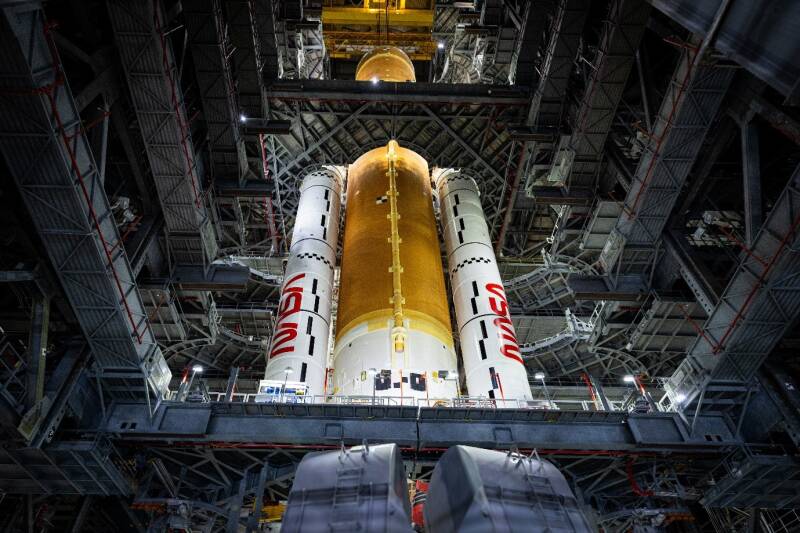
Credit - NASA/Frank Michaux
The decision follows a two-day flight readiness review in which NASA officials confirmed that engineering and mission teams had cleared the spacecraft and rocket for launch operations.
“All the teams polled ‘go’ to launch and fly Artemis II around the Moon, pending completion of some of the work before we roll out to the launch pad,” said Lori Glaze during a briefing Thursday.
She emphasized that the mission remains a test flight. “It’s a test flight, and it is not without risk. But our team and our hardware are ready.”
Mission Timeline and Launch Window
The mission must launch within a narrow window dictated by the alignment of the Earth and the Moon. NASA currently aims for liftoff at 6:24 p.m. EDT on April 1.
If the launch does not occur by April 6, the opportunity will close and the mission would likely slip by about a month.
Once launched, the four-person crew will embark on a nine-day journey around the Moon before splashing down in the Pacific Ocean.
The astronauts assigned to the mission are:
Reid Wiseman, mission commander,Victor Glover, pilot,Christina Koch, mission specialist and Jeremy Hansen, mission specialist
The flight will mark the first time astronauts travel beyond low Earth orbit since the Apollo era.
Delays and Technical Fixes
Originally planned for February, the mission was delayed after engineers detected hydrogen fuel leaks and later discovered an issue with the rocket’s upper-stage pressurization system.
Technicians first addressed the hydrogen leak at the launch pad by replacing suspect seals in the umbilical connections that feed propellant to the base of the rocket.
However, the upper-stage problem required more extensive work. Because the component was inaccessible at the pad, NASA rolled the rocket back into the Vehicle Assembly Building.
Once inside, engineers identified a displaced seal in a helium quick-disconnect fitting. Pressurized helium is essential for pushing propellants through the rocket’s propulsion system and clearing propellant lines.
After replacing the faulty seal, teams also completed additional maintenance tasks, including replacing batteries in the rocket’s flight termination system, solid rocket boosters, and both SLS stages. Engineers also charged batteries in Orion’s launch abort system.
According to Shawn Quinn, the repair work proceeded smoothly.
“I was very proud of the team and the work that they did to quickly understand the root cause and get us back in a posture to roll back out,” Quinn said. “So far, the VAB processing has gone very well.”
During the readiness review, mission risk was a major point of discussion. Because Artemis II will be the first crewed flight of the Space Launch System and Orion spacecraft, estimating the overall risk is challenging.
A recent report from NASA Office of Inspector General suggested that future lunar missions involving landers could carry an estimated 1-in-30 overall mission risk from launch to splashdown.
For comparison, astronauts flying during the Apollo program faced risks estimated at roughly 1-in-10.
Because Artemis II is not a lunar landing mission and the SLS rocket has flown only once before—during the uncrewed Artemis I—NASA officials said assigning precise risk numbers is difficult.
“I think sometimes we get tricked into believing those numbers tell us something critically important,” Glaze said, noting that risk assessments are more useful for relative comparisons rather than precise predictions.
The mission is part of NASA’s Artemis program, which aims to return astronauts to the Moon and eventually pave the way for human missions to Mars.
First announced during the administration of Donald Trump, the Artemis initiative originally targeted a lunar landing in 2024. Budget pressures, pandemic disruptions, and technical challenges pushed that milestone to 2028.
Under NASA’s revised mission plan, Artemis II will be followed by another mission next year in which astronauts in low-Earth orbit will rendezvous with lunar landers under development by SpaceX and Blue Origin. Those tests are intended to validate docking procedures and spacecraft systems before attempting a human landing.
If those missions succeed, NASA hopes to conduct one or two lunar landing missions in 2028, eventually transitioning to an annual cadence of Moon flights to build infrastructure for future Mars exploration.
A Journey Around the Moon
Like Artemis I, the upcoming mission will not enter lunar orbit. Instead, Orion will follow a “free-return” trajectory, looping around the far side of the Moon and using lunar gravity to slingshot back toward Earth.
Before departing for the Moon, the astronauts will spend their first full day testing Orion’s systems—including navigation, communications, and life-support—while operating in both low and high Earth orbit.
At closest approach, the spacecraft will pass about 4,100 miles above the lunar surface.
If the launch proceeds on schedule, the Artemis II crew will travel approximately 252,800 miles from Earth, farther than any humans have ventured since the Apollo era.
Add comment
Comments