

NASA is taking steps to reduce the risks associated with its upcoming Artemis missions to the Moon, but the agency’s approach still contains significant gaps, according to a new report released Tuesday by NASA’s Office of Inspector General (OIG).
The report highlights shortcomings in NASA’s current safety strategies, including incomplete testing plans for key lunar lander systems and limited analysis of how astronauts might survive after certain types of catastrophic but non-fatal incidents. The findings underscore the complexity of the Artemis program as NASA prepares to return astronauts to the lunar surface for the first time in more than half a century.
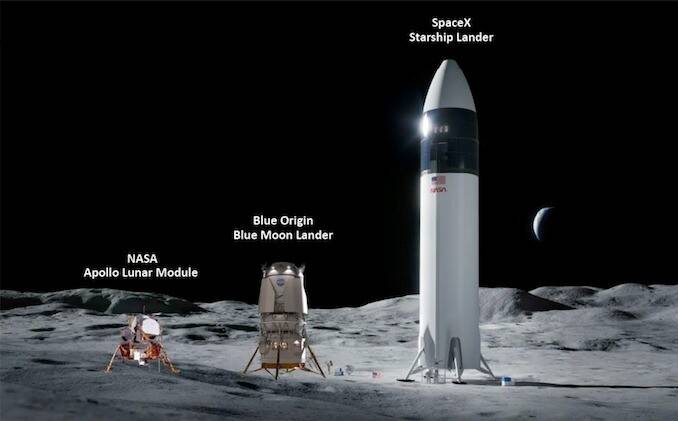
An artist’s impression of an Apollo-era lunar module (left) and moon landers being built by Blue Origin (center) and SpaceX (right)
No Rescue Capability in Lunar Emergencies
One of the most striking conclusions in the OIG report is that, similar to the Apollo era, NASA still lacks the capability to rescue astronauts if they become stranded on the Moon or in lunar orbit.
If Artemis astronauts were to face a life-threatening emergency during a mission—either in space or on the lunar surface—the agency currently has no practical way to launch a rapid rescue mission. This limitation echoes the reality faced by Apollo crews during the 1960s and 1970s, when astronauts operated far beyond the reach of immediate assistance.
While NASA is developing systems designed to prevent such emergencies, the OIG warned that gaps remain in the agency’s testing framework and in its assessments of crew survival scenarios following serious accidents.
The safety review comes as NASA prepares for the Artemis II mission, which will send astronauts around the Moon for the first time since 1972.
NASA engineers are currently readying the Space Launch System (SLS) rocket and the Orion crew capsule, named Integrity, for launch as early as April 1. The nine-day mission will carry four astronauts on a lunar flyby before returning to Earth.
Artemis II was initially targeted for early February, but technical problems forced delays. Engineers first dealt with hydrogen propellant leaks during testing and later discovered issues with the rocket’s upper-stage propellant pressurization system. The problems required rolling the rocket back to its processing facility for repairs.
NASA officials say the issue has now been resolved. The agency plans to conduct a formal Flight Readiness Review over two days this week. If approved, the SLS rocket will be transported back to Launch Complex 39B at Kennedy Space Center around March 19 or 20 to begin final launch preparations.
Meanwhile, NASA recently announced a significant restructuring of the Artemis program.
Under a new strategy unveiled by NASA Administrator Jared Isaacman on February 27, the agency plans to insert an additional mission into the timeline. The new mission, designated Artemis III, will fly an Orion spacecraft into Earth orbit next year to test docking procedures and perform checkout operations with one or both lunar landers currently under development.
These tests are intended to reduce risk before astronauts attempt to land on the Moon. If development progresses as planned, NASA hopes to conduct two crewed lunar landing missions in 2028.
Before those landings occur, both landers will also undergo uncrewed test flights to the Moon to validate their systems.
The OIG report was completed before this new mission architecture was announced, so its analysis focuses primarily on SpaceX’s Human Landing System (HLS), which had originally been expected to conduct the first two Artemis lunar landings before Blue Origin’s lander joined the program.
NASA now plans to use whichever lander is ready first.
SpaceX’s lander is a modified version of its Starship spacecraft, which normally functions as the upper stage of the company’s massive Super Heavy–Starship launch system.
To reach the Moon, the lunar lander version of Starship—standing roughly 171 feet tall—must be refueled in low Earth orbit before departing for lunar orbit. That process is expected to require between 10 and 20 tanker launches carrying super-cold propellants.
SpaceX plans to first launch an orbital propellant depot that will be gradually filled by a stream of tanker flights launched roughly once per week from facilities in Florida and Texas. Once the depot is full, the lunar lander will launch, refill its tanks from the depot, and then depart for the Moon.
However, orbital refueling at this scale has never been attempted. The OIG report noted that challenges such as the evaporation of cryogenic propellants—known as “boil-off”—remain unresolved publicly.
Blue Origin’s Blue Moon lander follows a somewhat similar strategy. Its vehicle would also be refueled in Earth orbit before heading to the Moon, where an additional tanker could replenish its tanks again before descending to the surface with astronauts.
The report also outlines the level of risk astronauts could face during the early Artemis landings.
NASA currently estimates that the first two lunar landing missions could face a loss-of-crew risk of roughly 1 in 40 during lunar operations, and 1 in 30 overall for the entire mission from launch to splashdown.
For comparison, Apollo missions carried an estimated risk of 1 in 10 for crew loss, while the Space Shuttle program ultimately operated with an approximate risk of 1 in 70.
Before astronauts land on the Moon, both lunar landers will undergo extensive tests in lunar orbit to verify their readiness. Once validated, astronauts traveling aboard Orion will dock with the lander, descend to the surface, and later return to the orbiting spacecraft.
South Pole Landing Challenges
Unlike Apollo missions, which landed near the lunar equator, Artemis astronauts will target locations near the Moon’s south pole. The region is scientifically valuable because it may contain water ice deposits in permanently shadowed craters, but it also presents difficult terrain.
According to the OIG, slopes in the region can reach 20 degrees, posing challenges for landing stability and navigation.
NASA’s landing requirement allows only an 8-degree tilt tolerance, meaning landers must touch down on relatively gentle slopes to ensure safe operations.
The large size of SpaceX’s Starship lander could complicate matters. At 171 feet tall—about the height of a 14-story building—the spacecraft’s momentum during landing could potentially cause it to tip over if it touches down on uneven terrain.
Blue Origin’s lander, at about 53 feet tall, also faces similar concerns if landing conditions exceed its tilt tolerance. For context, the Apollo lunar modules were roughly half the height of Blue Moon and seven times shorter than SpaceX’s Starship lander. Another engineering challenge highlighted in the report involves how astronauts will reach the lunar surface.
Astronauts using Blue Origin’s lander would descend via stairs to the surface, which is only about six feet below the vehicle’s hatch.
But crews aboard SpaceX’s Starship lander will rely on an external elevator positioned roughly 115 feet above the lunar surface—the equivalent of descending about ten stories. NASA officials consider the elevator a critical system. If it were to fail, astronauts currently would have no alternative way to climb back into the spacecraft from the Moon’s surface.
NASA requires spacecraft systems to be designed with at least single-failure tolerance, meaning that one failure should not lead to catastrophic consequences.
SpaceX is working to build a robust elevator system with redundant mechanisms, but the Artemis Human Landing System program is also exploring alternative ways for astronauts to re-enter the spacecraft if the elevator becomes stuck or stops functioning.
Despite the concerns, NASA officials say the agency is actively working with commercial partners to address the challenges identified in the report. The Artemis program remains one of the most ambitious space exploration efforts ever attempted, aiming to establish a sustained human presence near the Moon and eventually prepare for missions to Mars.
As testing continues and mission plans evolve, the findings from the Inspector General highlight the importance of rigorous safety planning before astronauts once again set foot on the lunar surface.
Add comment
Comments