

SpaceX is preparing for the first launch of the upgraded Starship Version 3 rocket, with CEO Elon Musk saying the debut test flight could occur in early April.
The launch, expected roughly four weeks after Musk’s March 7 announcement on X, would mark the 12th test flight of SpaceX’s massive Starship system and the first mission using the new V3 configuration. The upgraded rocket represents the latest step in the company’s effort to develop a fully reusable super-heavy launch system capable of missions to the Moon, Mars, and beyond.
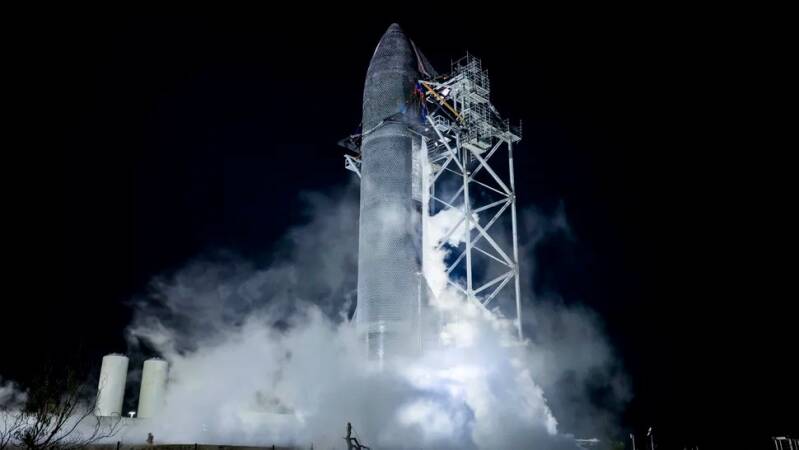
Starship V3 undergoes tests before launch. Credit: SpaceX
A Larger, More Powerful Starship
Version 3 introduces a range of upgrades to both components of the Starship system: the Super Heavy booster and the Ship upper stage.
Both stages are slightly taller than previous versions and will be powered by the next-generation Raptor 3 engines. These engines are designed to produce stronger and more efficient thrust, improving overall performance.
Earlier versions of Starship were already the most powerful rockets ever launched. With the V3 upgrades, SpaceX aims to push those capabilities even further, increasing payload capacity and improving reliability for future missions.
Lessons From Earlier Flights
The new version follows the end of the Starship V2 era, which concluded with Flight 11 in October last year.
The program had faced turbulence earlier in the year when the Ship upper stage exploded during its first three test flights of 2025—in January, March, and May. Those failures forced engineers to analyze the causes and implement design changes.
Despite the rocky start, the final two flights of the year were considered full successes, helping restore confidence in the system before the transition to Version 3 hardware.
The introduction of Starship V3 was itself delayed after an accident involving the first V3 Super Heavy booster.
In November, the booster experienced a mishap on a test stand at SpaceX’s Starbase facility in South Texas. The incident forced engineers to halt preparations and build a replacement booster, pushing the timeline for the upgraded rocket back by several months.
SpaceX says the new booster intended for Flight 12 will soon begin testing operations.
At the same time, the company has nearly completed construction of Starbase’s second launch pad, which will support the next phase of Starship testing.
Ship 39 Completes Key Testing
The upper stage designated for the next mission, Ship 39, has already completed a series of qualification tests.
According to SpaceX, engineers spent several days evaluating the spacecraft’s redesigned propellant systems and verifying the structural strength of the vehicle. These tests included so-called “squeeze tests,” which simulate the forces the spacecraft may experience during future recovery attempts.
The tests are part of SpaceX’s push to ensure the upgraded vehicle is ready for the rigors of launch and recovery.
Starship is designed to become the first fully reusable orbital launch system ever built.
SpaceX has already demonstrated partial success with booster recovery. The Super Heavy booster has returned to the launch site three times, where it was captured mid-air by the giant mechanical arms of the company’s launch tower—nicknamed “Mechazilla.”
With a second launch tower nearly ready, SpaceX is preparing for the next major milestone: catching the Ship upper stage in mid-air as it returns from space.
Achieving rapid turnaround and reuse is critical to SpaceX’s long-term strategy of dramatically reducing launch costs.
Starship is also central to NASA’s Artemis program, which aims to return astronauts to the Moon.
NASA selected SpaceX to develop a lunar landing version of Starship capable of transporting astronauts from lunar orbit to the Moon’s surface.
Originally, that lander was scheduled to support the Artemis III mission in 2028. However, recent changes to NASA’s lunar exploration roadmap have accelerated the timeline.
Under the updated plan, Artemis III is now expected to launch in 2027.
During the mission, NASA’s Orion spacecraft will carry astronauts to low Earth orbit, where it will rendezvous and dock with one or more lunar landers under development.
Starship is not the only vehicle competing for a role in Artemis landings.
NASA has also selected Blue Origin’s Blue Moon lander for future missions. Under the revised program structure, the space agency may use whichever lander is ready first when the mission launches.
If only one of the two vehicles is flight-ready in time, the competing lander could miss the opportunity to perform the first crewed lunar landing of the Artemis era, which may instead occur on Artemis IV.
Countdown to Flight 12
With testing underway and launch infrastructure nearing completion, SpaceX appears to be entering a critical phase of Starship development.
If Musk’s timeline holds, the upcoming Flight 12 mission could mark the first real-world demonstration of Starship’s most advanced design yet—bringing the company one step closer to its goal of routine, reusable deep-space transportation.
Add comment
Comments
Thanks for the update. Fingers crossed for the mission