

Scientists analyzing samples returned by China’s Chang'e 6 mission have revised the long-standing model used to date lunar craters, offering new insight into the Moon’s ancient impact history. The research, conducted by teams from the Chinese Academy of Sciences’ Institute of Geology and Geophysics and the Aerospace Information Research Institute along with international collaborators, analyzed material collected from the Moon’s far side together with orbital remote-sensing data. Their findings, published in the journal Science Advances, show that meteorite impacts have struck the Moon’s near and far hemispheres at essentially the same rate over time.
The results challenge earlier hypotheses suggesting the Moon’s far side may have experienced more intense bombardment than the hemisphere facing Earth. Instead, the study supports the use of a single global crater-dating framework for the entire lunar surface.
Impact craters act as a record of meteorite bombardment stretching back to the Moon’s formation more than four billion years ago. Since the first telescopic observations by Galileo Galilei revealed the Moon’s cratered landscape, scientists have recognized that regions with more craters are typically older.
After the Apollo program and the Luna program returned rock samples from the Moon’s near side, researchers were able to link crater density with precise radiometric ages. This relationship became known as the lunar cratering chronology function, a crucial tool that allows scientists to estimate the ages of large regions of the Moon that have never been sampled.
The same technique has also been applied to date geological features across other rocky worlds in the inner Solar System.
However, all samples used to calibrate the chronology had come from the Moon’s near side, leaving open the possibility that impact histories might differ between hemispheres. Some studies suggested that variations in crustal structure or gravitational shielding by Earth might have influenced the distribution of impacts.
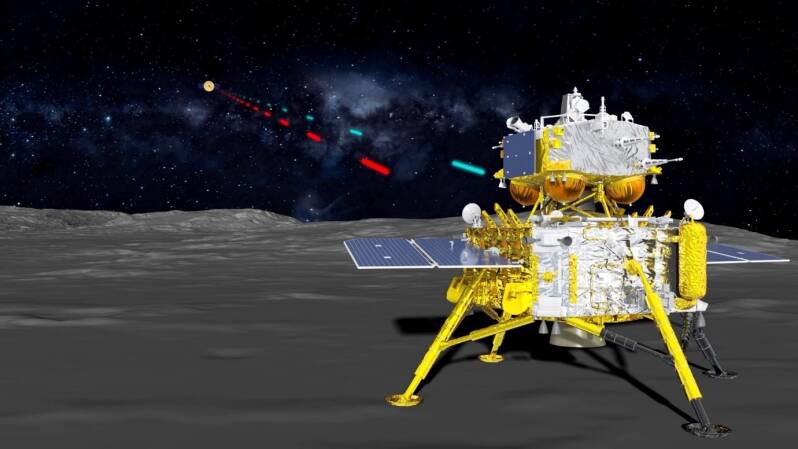
The far side had remained a missing piece of the puzzle—until Chang’e-6.
Samples From One of the Moon’s Oldest Basins
Chang’e-6 was designed to retrieve material from the lunar far side, an area never previously sampled. The spacecraft landed in the Apollo Basin, which lies within the enormous South Pole–Aitken Basin. This region preserves some of the oldest geological records of impacts in the inner Solar System.
Laboratory analysis shows that most of the returned material consists of local basaltic rock with an age of about 2.807 billion years. This provided researchers with a crucial far-side calibration point. By comparing the age of the rocks with crater densities in the surrounding region, scientists could test whether the far side followed the same crater-dating curve derived from near-side samples.
The samples also contained fragments of noritic rock dated to roughly 4.247 billion years. Geological and mineral evidence indicates these rocks likely formed as impact melt during the creation of the South Pole–Aitken Basin, providing a rare direct constraint on one of the Moon’s earliest major collision events.
A Revised Lunar Impact Timeline
Researchers first reconstructed the traditional lunar crater chronology using well-established near-side calibration points and their measured crater densities. When the new Chang’e-6 ages and crater counts were plotted on the same curve, the results fell within the model’s statistical confidence range.
This agreement indicates that the rate of meteorite impacts on the Moon’s near and far sides has been statistically indistinguishable over billions of years. With that validation, scientists created an updated global chronology model that incorporates the new far-side data.
The revised timeline shows that impact rates declined steadily during the Moon’s early history rather than spiking dramatically around 3.9 billion years ago, a period previously associated with the proposed Late Heavy Bombardment.
For decades, many Apollo samples appeared to cluster around that age, leading scientists to suggest the inner Solar System experienced a short but intense surge in impacts at that time. However, some researchers argued that the clustering might simply reflect debris thrown out by the formation of the Moon’s Imbrium Basin rather than evidence of a system-wide event.
The Chang’e-6 data now lend weight to the alternative view. The newly dated 4.247-billion-year-old rocks indicate that major basin-forming impacts such as South Pole–Aitken likely occurred earlier than previously inferred, while the overall bombardment rate gradually decreased after the main phase of planetary formation.
The new results suggest that the Moon—and likely other rocky worlds—did not experience a sudden, system-wide spike in impacts around 3.9 billion years ago. Instead, the impact environment appears to have evolved through a steady decline in collision rates over time.
Beyond resolving debates about the Moon’s bombardment history, the updated chronology improves scientists’ ability to estimate the ages of unsampled regions of the lunar surface. A more reliable global cratering model will help researchers interpret the geological evolution of the Moon, guide the selection of future landing sites, and refine age estimates for surfaces on planets such as Mars and Mercury.
The study also highlights the scientific value of exploring the Moon’s far side. By bringing back the first samples ever collected from that hemisphere, Chang’e-6 has allowed researchers to test models built entirely from near-side observations and significantly deepen our understanding of the early Solar System.
Add comment
Comments