

NASA has officially selected the Centaur V upper stage, developed by United Launch Alliance, to fly on the agency’s Space Launch System rocket beginning with the Artemis 4 mission, which is currently scheduled to launch no earlier than early 2028.
The decision marks a significant change in NASA’s plans for the Artemis lunar exploration program. The move replaces the long-planned transition to the Exploration Upper Stage (EUS), which had been under development by Boeing. NASA disclosed the decision in procurement documents released Friday, just days after NASA Administrator Jared Isaacman announced a broader effort to simplify and standardize the SLS rocket fleet.
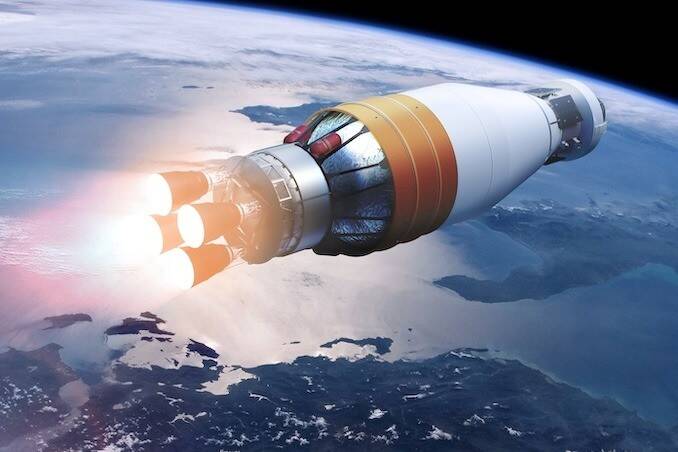
An artist’s rendering of the Exploration Upper Stage (EUS), a four-engine liquid hydrogen/liquid oxygen in-space stage on the Space Launch System (SLS) Block 1B and Block 2 rockets. Image: NASA
Speaking during a briefing at Kennedy Space Center on Feb. 27, Isaacman said the agency intends to move toward what he described as a “near-Block 1 configuration” of the SLS rocket. According to him, the goal is to reduce system complexity, accelerate manufacturing, and increase the launch rate of the vehicle. He noted that simplifying the architecture could also improve safety by allowing NASA to produce and launch rockets more efficiently.
Under the original plan for the Artemis program, the first three SLS missions were to fly with the Interim Cryogenic Propulsion Stage (ICPS), a modified version of the Delta IV Cryogenic Second Stage supplied by ULA. Beginning with Artemis 4, NASA intended to introduce the larger and more powerful Exploration Upper Stage, enabling the SLS Block 1B configuration. However, mounting cost overruns and schedule delays tied to the EUS program ultimately pushed NASA to reconsider its strategy.
Centaur V was initially designed as the upper stage for ULA’s Vulcan Centaur launch vehicle. Since the Vulcan rocket made its debut in January 2024, the vehicle has completed four flights, with the Centaur V stage performing successfully on each mission. NASA officials cited the stage’s reliability and compatibility with existing SLS infrastructure as key factors behind the selection.

An infographic illustrating the differences between the Centaur 3 and the Centaur 5 upper stages. Graphic: ULA
In supporting documentation prepared by engineers at Marshall Space Flight Center, the agency highlighted the decades-long operational heritage of the RL10 engine that powers the Centaur stage. The RL10 engine has evolved through multiple generations and has built a reputation as one of the most dependable hydrogen-fueled rocket engines ever flown. NASA also noted that the Centaur V design can integrate with the existing Mobile Launcher 1 infrastructure and use the same liquid hydrogen and liquid oxygen propellants already employed by the SLS system. In addition, ULA engineers have extensive experience working with NASA’s Exploration Ground Systems teams at Kennedy Space Center and other facilities.
Another advantage cited by the agency is the certification of the earlier Centaur III stage for human spaceflight as part of NASA’s Commercial Crew Program. Because Centaur V shares several design features with that earlier variant, NASA believes the transition will require relatively modest modifications. The agency stated that the approach allows it to leverage existing hardware and support systems while avoiding the need for entirely new development work.
NASA intends to award the contract for the SLS upper stage to ULA on a sole-source basis, meaning the company will be the only supplier considered for the new configuration. Officials said that tight scheduling requirements played a major role in the decision. Processing for an SLS launch at Kennedy Space Center typically begins roughly nine months before liftoff, and selecting a different contractor could introduce delays tied to procurement procedures, workforce changes, hardware redesign, and additional testing needed to meet SLS technical requirements.
One potential alternative might have been an upper stage derived from Blue Origin’s New Glenn rocket. However, NASA determined that adapting the New Glenn Stage 2 to the SLS architecture would require substantial changes to both the stage and the launch infrastructure at Kennedy Space Center. Engineers concluded that the modifications would include relocating the Mobile Launcher crew access arm and redesigning elements of the upper-stage umbilical retraction system. The stage might also need to be shortened to meet height limits inside the Vehicle Assembly Building, a change that would require extensive development and full-scale qualification testing. NASA said such work would likely introduce unacceptable schedule delays and additional cost risk to the SLS program.
The decision effectively sidelines the Exploration Upper Stage, which had long been envisioned as the centerpiece of the more powerful SLS Block 1B configuration. That upgrade was designed to enable more ambitious lunar missions by allowing the rocket to deliver significantly more cargo to the Moon, including as much as 11 metric tons of additional payload compared with the current Block 1 configuration.
Despite those ambitions, the EUS program has struggled with cost growth and schedule delays. A 2024 report by NASA’s Office of Inspector General found that development of the SLS Block 1B configuration had been underway since 2014 but remained behind schedule, in part due to quality control issues at the Michoud Assembly Facility. The report estimated that total development costs for the Block 1B system could reach approximately $5.7 billion by the time of its planned debut in 2028, exceeding NASA’s previous baseline by roughly $700 million. According to the analysis, development of the Exploration Upper Stage itself accounted for more than half of that cost growth, with projected spending rising from about $962 million in 2017 to nearly $2.8 billion through 2028.
Delivery timelines for the stage had also slipped significantly. At the time of the report, the expected delivery date had moved from February 2021 to April 2027, raising concerns that Artemis 4 could face further delays. Boeing engineers had continued development work through 2025, including welding and testing major structural components of the stage’s liquid oxygen tank. Plans were also in place to conduct a full “green run” test of the stage at Stennis Space Center, which would have involved loading the stage with propellants and firing all four RL10 engines in a full-duration static fire test.
With NASA now moving forward with the Centaur V approach, it remains unclear what will happen to the Exploration Upper Stage hardware currently in development or whether the planned testing campaign will proceed.
Add comment
Comments