

In a sweeping reset of America’s return-to-the-moon strategy, newly appointed NASA Administrator Jared Isaacman announced Friday that the agency will restructure its Artemis program, adding a crucial preparatory mission in 2027 and redefining the timeline for landing astronauts on the lunar surface. Isaacman acknowledged that NASA’s earlier plan to land astronauts near the moon’s south pole in 2028 was overly ambitious without an additional stepping-stone mission to validate critical technologies and operational procedures. “We’re going to get there in steps,” he said in an interview with CBS News and later during a press conference. “We’ve got to get back to basics.”
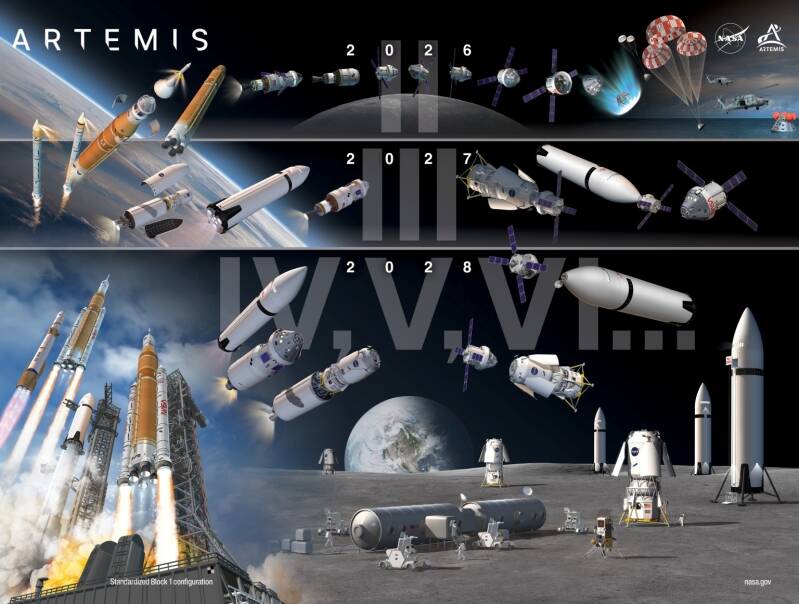
A graphic illustrating NASA’s increased cadence of Artemis missions. Credit: NASA
A New Artemis III: Docking in Earth Orbit Before Heading to the Moon
Under the revised architecture, the mission previously known as Artemis III — once envisioned as the first crewed lunar landing since Apollo — will instead launch in 2027 on a non-lunar test flight in low-Earth orbit.
During that mission, astronauts will rendezvous and dock with one or both commercially developed human landing systems currently being built by SpaceX and Blue Origin. The objective is to conduct integrated tests of navigation, propulsion, communications, life support systems and docking procedures in space before committing to a high-stakes lunar descent.
The mission will also provide astronauts with the opportunity to evaluate next-generation commercial spacesuits intended for future moonwalkers. Even without performing a spacewalk, Isaacman said, operating the suits in microgravity will yield valuable insights.
The approach echoes the strategy used during the Apollo era. In 1969, NASA flew Apollo 9 in Earth orbit to test the lunar module before attempting the Apollo 11 landing months later. Isaacman described the new plan as a similar risk-reduction step designed to “buy down risk” before attempting a lunar touchdown.
If the 2027 docking mission proves successful, NASA intends to move forward with at least one — and possibly two — crewed lunar landing missions in 2028, now designated Artemis IV and Artemis V. Those flights would incorporate lessons learned from the Earth-orbit test mission.
Which lunar lander is used will depend on readiness. If only one provider’s vehicle is certified, it would support both missions. If both companies’ systems are ready, each could fly separately.
Both SpaceX and Blue Origin are already planning uncrewed lunar landing demonstrations under their existing contracts. NASA officials said Isaacman has discussed accelerating development timelines with both companies, and both are aligned with the revised plan.
The overhaul follows the release of a sharply critical report from NASA’s independent Aerospace Safety Advisory Panel, which warned that the original Artemis III architecture required too many simultaneous “firsts” — new landers, new spacesuits, complex docking maneuvers and surface operations — creating an unbalanced risk posture.
Isaacman said the agency’s revised approach directly addresses those concerns. “We are completely aligned,” he said, noting that many of the panel’s observations were self-evident.
The restructuring comes as NASA continues to work through technical challenges with Artemis II, the first crewed test flight of the Space Launch System and Orion spacecraft around the moon.
Originally targeted for early February, Artemis II has been delayed first by a hydrogen leak and more recently by a helium pressurization issue in the rocket’s upper stage. Launch is now on hold until at least April 1.
Those setbacks underscored the broader concern that NASA was attempting to leap from a single crewed lunar flyby directly to a complex landing mission without sufficient incremental testing.
“We should have made better decisions,” Isaacman said. “You don’t go from Artemis II to landing on the moon with Artemis III.”
Streamlining the Space Launch System
In another major change, NASA will halt development of the more powerful Exploration Upper Stage (EUS) version of the Space Launch System. Instead, the agency will standardize the rocket’s configuration, continuing to fly the current core vehicle with a less complex upper stage that avoids the need for major modifications and a taller mobile launch tower.
Under the previous plan, NASA intended to transition from the current Block 1 SLS configuration to a more powerful Block 1B with EUS and eventually to an even larger Block 2 variant. That progression required new infrastructure and extensive reconfiguration between flights.
Amit Kshatriya, NASA’s associate administrator, said altering the SLS and Orion stack between missions added unnecessary complexity. The revised strategy emphasizes evolutionary capability growth rather than large architectural leaps.
Isaacman argued that a higher launch tempo — moving from one Artemis mission every few years to roughly one per year — is essential not only for schedule reasons but for safety.
“When you regain these core competencies and you start exercising your muscles, your skills do not atrophy,” he said. “It’s safer.”
The administrator emphasized that he does not blame contractors such as Boeing, Lockheed Martin or United Launch Alliance for the program’s slow cadence. Instead, he suggested that NASA leadership should have adopted a more incremental strategy from the outset.
Beyond hardware and schedules, Isaacman said Artemis must ultimately support a broader economic vision. Sustained exploration cannot rely indefinitely on taxpayer funding alone.
“There’s another ingredient that’s required, and that’s the orbital economy,” he said. “We’ve got to do something where we can get more value out of space and the lunar surface than we put into it.”
By adopting a step-by-step, Apollo-inspired framework, NASA hopes to increase its chances of successfully returning astronauts to the moon in 2028 — not through bold leaps, but through deliberate, risk-conscious progress.
Add comment
Comments