

NASA officials say they have yet to reestablish communication with the agency’s MAVEN Mars orbiter, more than three months after contact was unexpectedly lost.
The spacecraft — formally known as MAVEN — went silent on Dec. 6, 2025, as it emerged from behind Mars. Prior telemetry indicated the orbiter was functioning normally, with no signs of malfunction. However, a fragment of tracking data from the day of the outage suggests the spacecraft began rotating abnormally and may have drifted out of its intended orbit.
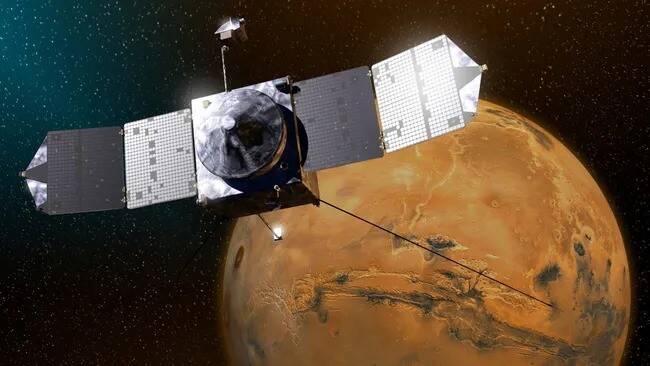
An artist's depiction of NASA's MAVEN spacecraft at work around Mars. (Image credit: NASA/GSFC)
Speaking at the Lunar and Planetary Science Conference in Texas, Louise Prockter said no signals have been detected since communication attempts resumed in mid-January following a planned blackout caused by solar conjunction — a period when the Sun blocks or interferes with signals between Earth and Mars.
“We haven’t officially said MAVEN is lost yet,” Prockter noted. “We’re still looking for it.”
To aid recovery, NASA has expanded its search efforts beyond the Deep Space Network, bringing in additional facilities such as the Green Bank Observatory. Engineers even attempted to locate the orbiter from the Martian surface by instructing the Curiosity rover to scan the sky, but no trace of MAVEN was found.
Despite these efforts, prospects for recovery appear slim. Earlier assessments described the chances as “very unlikely” after the spacecraft remained unresponsive for over a month. NASA has since convened an internal review board to evaluate possible failure scenarios and determine whether further recovery attempts are warranted.
Launched in 2013, MAVEN has played a critical role in understanding Mars’ climate evolution, studying how the planet lost its atmosphere and transformed from a warmer, wetter world into the cold desert seen today. Originally designed for a one-year mission, the orbiter far exceeded expectations, marking over a decade of operations.
Beyond its scientific contributions, MAVEN has also served as a communications relay, handling roughly 20% of data transmission between Earth and surface missions like Perseverance rover and Curiosity.
With MAVEN offline, other orbiters — including Mars Reconnaissance Orbiter, Mars Odyssey, and the European Space Agency’s Trace Gas Orbiter — are taking on increased relay responsibilities. NASA has also adjusted daily operations for its rovers to ensure continued scientific output.
Looking ahead, NASA is evaluating options to bolster its aging Mars communications network. This includes potential replacement missions, supported in part by recent U.S. funding for a next-generation Mars telecommunications orbiter. Private-sector proposals are also emerging, with Blue Origin outlining plans for a dedicated Mars relay satellite that could launch later this decade.
“We know that they’re not all going to last forever,” Prockter said. “The agency is thinking about what is next for Mars.”
For now, however, MAVEN remains silent — and its fate uncertain.
Add comment
Comments