

In a historic breakthrough for commercial spaceflight, SpaceX has successfully launched Starship Flight 14, marking the first time the world's largest and most powerful rocket has achieved Earth orbit.
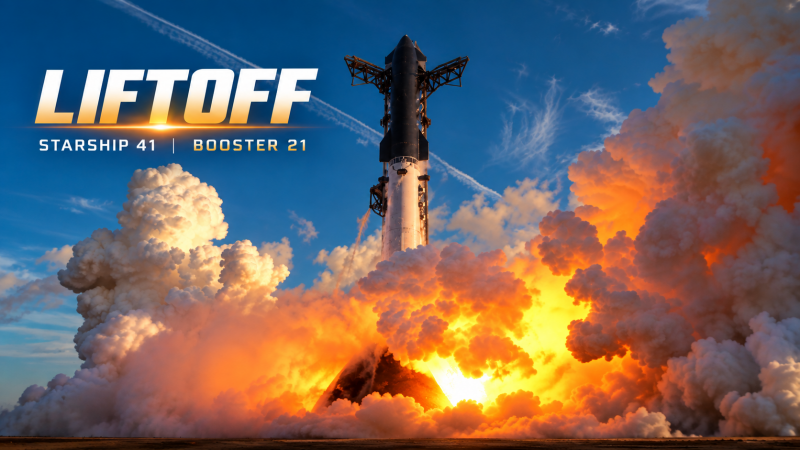
Liftoff of Starship Flight-14. Credit: SpaceX ( edited)
Lifting off from Pad 2 at the SpaceX Starbase facility in Boca Chica, Texas, at 8:48 a.m. EDT on September 28, 2026, the massive 124-meter-tall vehicle overcame dramatic mid-flight engine anomalies to cross its most crucial developmental milestone yet.
High Drama During Ascent The uncrewed launch of Booster 21 and Ship 41 initially proceeded smoothly, with all 33 Raptor engines on the Super Heavy booster igniting to push the rocket off the pad. However, the mission quickly turned into a tense, edge-of-your-seat affair:
●Booster Performance: One or two booster engines failed during the initial sequence, but the Super Heavy booster successfully completed its hot-staging separation. It returned to execute a practice landing burn over the Gulf of Mexico, resulting in a soft splashdown despite not all landing engines relighting as planned.
●Upper Stage Crisis: During the upper stage's climb to space, Ship 41 suffered an outage in one of its six Raptor engines.
●The Orbital Decision: The loss of the engine raised immediate doubts about whether the spacecraft could achieve orbit. After a brief period where spokespersons suggested the orbital attempt might be called off, mission control gave the green light to press forward. Roughly 25 minutes after liftoff, a brief insertion burn officially put Starship into orbit.
First Revenue-Generating Payload
Beyond proving its orbital capability, Flight 14 marked a major shift for the program from developmental testing to operational execution. It served as SpaceX's first revenue-generating Starship flight.
Once in orbit, Starship successfully deployed a payload of 26 next-generation Starlink V3 satellites. According to SpaceX mission details, these upgraded satellites will add massive data capacity to the worldwide internet constellation, solidifying Starship’s role as the company’s future commercial workhorse.
A Shortened Mission and Pacific Splashdown
While the original flight profile outlined an ambitious 10-hour mission consisting of six full revolutions around Earth, the engine complications forced flight managers to adapt. To ensure maximum safety, SpaceX engineers opted to end the mission early, reducing the orbital duration to approximately three hours and two orbits. Starship then initiated its deorbit burn, braving atmospheric reentry before executing a controlled landing maneuver that concluded in a massive fireball and splashdown in the North Pacific Ocean.
Looking Forward
By successfully putting Starship into orbit, SpaceX has cleared a massive technical hurdle. This success opens the door for rapid, iterative testing of full vehicle reusability and brings NASA one step closer to utilizing Starship for its upcoming Artemis moon landings. If you would like to track the next steps for the program, I can provide more details on the upcoming Starship Flight 15 goals or update you on the status of the deployed Starlink V3 network. Which would you prefer to explore?
Add comment
Comments