

NASA is about to change how we see the universe—again.
On August 30, 2026, at 7:26 a.m. EDT, the long-awaited Nancy Grace Roman Space Telescope is scheduled to take to the skies. Lifting off atop a SpaceX Falcon Heavy rocket from historic Launch Complex 39A at the Kennedy Space Center in Florida, Roman will embark on a million-mile journey. Its mission? To uncover the cosmos' most fiercely guarded secrets: the nature of dark energy, the distribution of dark matter, and the hidden exoplanets waiting in the dark.
100 Times the View
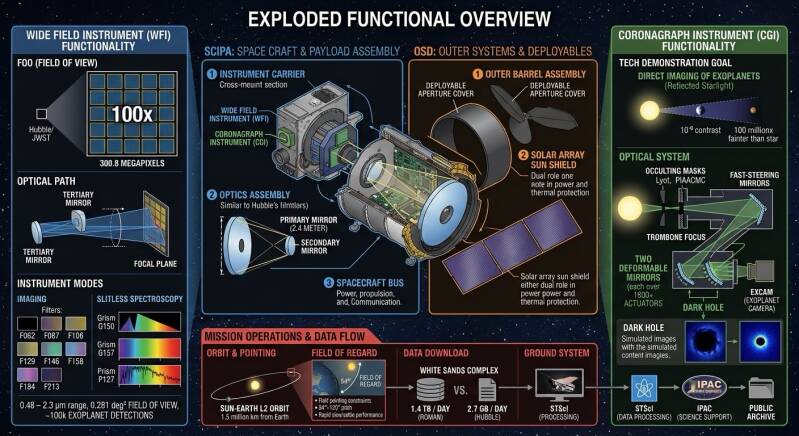
If the Hubble Space Telescope is a telephoto lens capturing exquisite, zoomed-in portraits of the cosmos, the Roman Space Telescope is the ultimate wide-angle lens. Roman features a 2.4-meter primary mirror—the exact same size as Hubble's. However, thanks to a revolutionary 300-megapixel Wide Field Instrument with 18 individual detectors, Roman boasts a field of view 100 times larger than Hubble's.To put that into perspective: a single image from Roman would require thirty-seven 4K Ultra HD screens tiled together just to display it at its native resolution. This sweeping gaze allows Roman to survey vast stretches of the cosmos exponentially faster than previous observatories. Over its planned five-year primary mission, NASA expects Roman to map billions of galaxies and discover roughly 100,000 new worlds.
It will also act as a phenomenal data firehose, beaming down a staggering 1.4 terabytes of data back to Earth every single day—the most of any space telescope NASA has ever built. All of this data will be immediately available to the public, turning anyone with an internet connection into a digital astronaut.

Photo by : Dhanushka Nilanga

Photo by : Dennis Hlavsa
A Million-Mile Journey to L2
Unlike satellites that closely orbit the Earth, Roman has a much longer commute ahead of it. After separating from the Falcon Heavy, the spacecraft will spend about a month cruising to the second Sun-Earth Lagrange point, or L2.
Located about 1.5 million kilometers (930,000 miles) away from our planet, L2 is a gravitational sweet spot where the pull of the Sun and Earth balance out. This allows the telescope to maintain a highly stable position with an unobstructed view of deep space, safe from the glaring light and thermal interference of Earth. It’s the same neighborhood currently occupied by the James Webb Space Telescope.
Once it arrives, Roman will spend roughly three months undergoing rigorous testing, calibration, and commissioning of its instruments before science observations officially begin in early 2027. If the timeline holds, we could expect to see the first stunning images beamed back by early December.
The "Mother of Hubble" Legacy
The telescope bears the name of Dr. Nancy Grace Roman, NASA’s first Chief Astronomer and the first woman to hold an executive position at the agency. Joining NASA in 1959, Dr. Roman was a tireless advocate for space-based astronomy. She famously championed the idea that to truly see the universe, we needed to put telescopes above the blurring effects of Earth's atmosphere.
Her relentless work eventually paved the way for the Hubble Space Telescope, earning her the affectionate title, the "Mother of Hubble". It is only fitting that the observatory designed to pick up right where Hubble left off—hunting for the invisible forces that shape our universe—carries her name.
As the countdown clock ticks closer to August 30th, astronomers and space enthusiasts around the world are holding their breath. The universe is about to get a whole lot bigger.
The new telescope 100x better than Hubble | Nancy Grace Roman Explained This video provides a great visual breakdown of how Roman compares to Hubble and explains its mission to map dark matter and dark energy in an easy-to-understand way.

This NASA/ESA Hubble Space Telescope image features the spiral galaxy NGC 4654, located 72 million light-years away in the constellation Virgo (the Maiden). NASA, ESA/Hubble, D. Thilker, J. Lee, and the PHANGS-HST Team
Article by : Dhanushka Nilanga
Add comment
Comments