

Blue Origin has completed its investigation into the partial failure of the third flight of its New Glenn rocket, clearing the way for the heavy-lift vehicle to return to flight operations. In a statement released May 22, the company confirmed that the Federal Aviation Administration approved the final mishap report for the April 19 NG-3 mission, during which the rocket’s upper stage suffered a malfunction that prevented its payload from reaching its intended orbit.
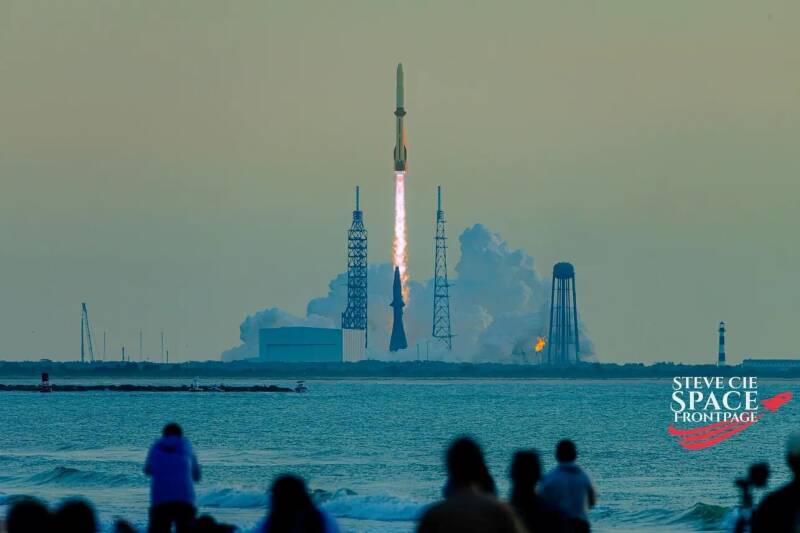
The mission carried the BlueBird 7 satellite for AST SpaceMobile, but the spacecraft was stranded in an orbit too low to recover after the anomaly occurred during the second burn of the New Glenn upper stage, known internally as GS2.
According to Blue Origin, the issue began shortly before the second-stage restart in space.
“Prior to our second GS2 burn, we experienced an off-nominal thermal condition, and, as a result, one of the BE-3U engines didn’t achieve full thrust to reach our target orbit,” the company stated. The FAA later provided additional details, confirming that the root cause of the anomaly was traced to a cryogenic leak within the upper stage propulsion system.
“The final mishap report identified the direct cause of the mishap as a cryogenic leak that froze a hydraulic line and led to a thrust anomaly during the second-stage engine burn,” the agency said.
Despite the setback, regulators have officially closed the investigation and authorized New Glenn launches to resume, although the FAA noted that Blue Origin must complete a series of corrective measures before the rocket can fly again. According to the agency, Blue Origin identified nine corrective actions aimed at preventing similar failures in future missions. Specific details about those corrective actions were not disclosed publicly.
“The FAA will verify that Blue Origin implements corrective actions prior to the launch of the next New Glenn mission,” the agency added. The investigation’s conclusion marks an important step for Blue Origin as it continues developing New Glenn into a major competitor in the commercial heavy-launch market currently dominated by SpaceX.
The NG-3 anomaly represented one of the most significant in-flight issues for the rocket program to date, particularly because it occurred during a critical orbital insertion maneuver. However, industry observers noted that upper-stage problems are relatively common during the early operational years of new launch systems.
AST SpaceMobile executives expressed confidence that Blue Origin would recover quickly from the setback.
“An upper-stage anomaly like this is not uncommon early in programs, and we feel optimistic about them getting back to the pad soon,” said Scott Wisniewski, the company’s chief strategy officer, during a May 11 earnings call. While Blue Origin has not yet announced a launch date for the upcoming NG-4 mission, preparations for the next vehicle already appear to be underway.
Earlier on May 22, Blue Origin Chief Executive Dave Limp shared video footage showing a new New Glenn rocket being installed onto a transporter-erector system ahead of testing.
“Next stop integrated hotfire,” Limp wrote in a social media post.
The company has not identified the payload customer for NG-4, nor provided a launch timeline. Meanwhile, AST SpaceMobile has shifted some near-term launch plans to SpaceX. The company recently shipped three additional BlueBird satellites to Florida for launch aboard a Falcon 9 rocket scheduled for June.
Wisniewski also revealed that AST’s next New Glenn mission is expected to carry four BlueBird satellites, though no timeframe for that flight has been announced.
New Glenn is central to Blue Origin’s ambitions in the commercial and national security launch markets. The partially reusable heavy-lift rocket is designed to compete for government contracts, satellite deployment missions, and future deep-space exploration campaigns.
With the FAA investigation now closed and corrective actions underway, Blue Origin appears poised to return the rocket to flight as it continues refining the vehicle during its early operational phase.
Add comment
Comments