

SpaceX successfully launched the first flight of its redesigned “Version 3” Super Heavy-Starship rocket on Friday evening, marking a major milestone in the company’s push toward fully reusable deep-space transportation systems for missions to the Moon and Mars. The towering 407-foot-tall vehicle lifted off at 6:30 p.m. EDT from SpaceX’s upgraded second launch pad at SpaceX’s Starbase facility in Texas. The mission served as the debut of the company’s heavily upgraded Starship V3 architecture, featuring more powerful Raptor 3 engines, enhanced flight-control systems, improved heat-shield performance, and infrastructure designed for rapid reusability.
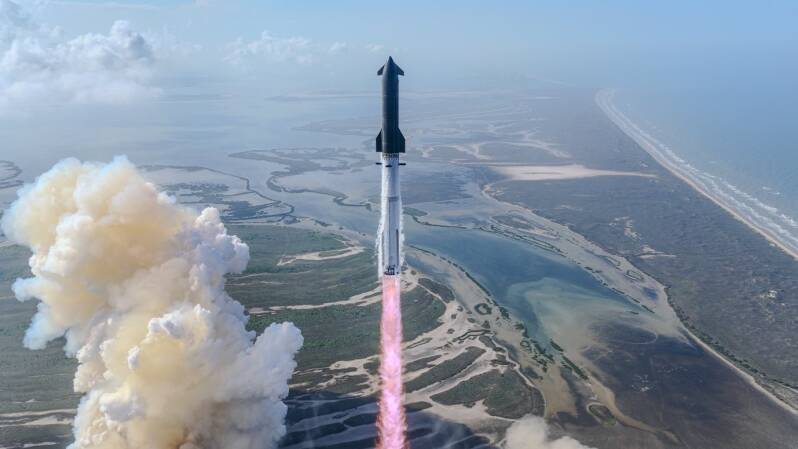
Credit: SpaceX
Although the mission experienced multiple engine-related issues during ascent and booster recovery, the overall flight was widely viewed as a success after the spacecraft completed several key objectives, including satellite deployment, atmospheric re-entry testing, and a controlled splashdown in the Indian Ocean.
Generating an estimated 18 million pounds of thrust — roughly twice the liftoff power of NASA’s Space Launch System rocket — the Super Heavy booster roared away from the Texas coast powered by 33 methane-fueled Raptor engines, sending the massive spacecraft skyward atop a brilliant plume of blue-white exhaust.
The launch came after several delays earlier in the week, including weather holds and a last-minute scrub Thursday caused by a minor launch-pad system issue.
Shortly after liftoff, however, one of the booster’s 33 engines shut down during the climb through the lower atmosphere. Additional Raptor engines later failed to operate properly during the booster’s return maneuver toward its planned splashdown zone in the Gulf of Mexico.
About two minutes and 24 seconds into flight, the Starship upper stage ignited its six Raptor engines and separated cleanly from the Super Heavy booster. The booster then flipped as planned to begin its return trajectory toward Texas waters, but multiple engine failures prevented it from reaching its intended splashdown target, likely causing it to impact the Gulf short of the planned zone.
Meanwhile, the Starship upper stage continued its ascent despite another engine anomaly. One of the spacecraft’s three vacuum-optimized Raptor engines shut down prematurely during the climb to space. Flight computers compensated by extending the burn time of the remaining five engines, allowing the spacecraft to still achieve an acceptable sub-orbital trajectory.
Despite the propulsion issues, the mission successfully completed several high-priority objectives once in space.
Starship deployed 22 simulated Starlink satellites using a newly upgraded payload dispenser system resembling a giant “Pez” mechanism. Two of the simulators carried cameras that transmitted dramatic images back to Earth showing the spacecraft from an external perspective.
SpaceX says similar camera systems will eventually help engineers inspect Starship’s heat shield condition during future missions.
A planned in-space Raptor engine restart test was skipped following the ascent engine issue, but the spacecraft otherwise appeared to perform strongly during orbital operations.
The most significant success of the mission may have come during re-entry.
As Starship plunged back through Earth’s atmosphere, the spacecraft appeared to withstand extreme heating far better than earlier test flights, showing little visible thermal damage. During descent, the ship also executed aggressive maneuvering tests, including a structural stress evaluation of its rear fins and a dramatic banking maneuver intended to simulate future landing profiles.
Moments before reaching the Indian Ocean, Starship reignited two engines, flipped into a vertical orientation, and carried out a controlled splashdown precisely on target. As expected, the vehicle later tipped over, broke apart, and exploded in a massive fireball after impact.
The overall performance prompted praise from Elon Musk, who celebrated the mission on social media.
“Congratulations @SpaceX team on an epic first Starship V3 launch & landing!” Musk wrote on X. “You scored a goal for humanity.”
NASA Administrator Jared Isaacman, who traveled to Texas to witness the launch in person, also praised the achievement.
“Congrats @SpaceX team and @elonmusk on a hell of a V3 Starship launch,” Isaacman posted. “One step closer to the Moon…one step closer to Mars.”
The Version 3 flights represent a critical phase in SpaceX’s long-term strategy to transform Starship into the world’s first fully reusable super-heavy launch system capable of carrying satellites, cargo, science probes, and eventually humans across the solar system.
The program also plays a central role in NASA’s Artemis Program, under which SpaceX is developing a specialized lunar lander version of Starship to transport astronauts to the Moon beginning later this decade.
NASA currently plans to launch the next Artemis mission in 2027 using an Orion spacecraft and SLS rocket, with astronauts expected to rendezvous in Earth orbit with lunar landers being developed by both SpaceX and Blue Origin.
Before astronauts can attempt a lunar landing in 2028, both companies must first demonstrate successful uncrewed moon landing missions — a major challenge that will require rapid development and repeated testing.
One of the most difficult technical hurdles ahead is orbital refueling, a capability considered essential for deep-space Starship missions. The new Version 3 spacecraft includes upgraded fuel-transfer plumbing and attachment hardware specifically designed to support autonomous refueling operations in orbit.
SpaceX says the first orbital propellant transfer demonstrations could begin before the end of the year as the company works to transition from sub-orbital test flights to fully operational orbital missions.
Add comment
Comments