

Lockheed Martin has announced it will join forces with Firefly Aerospace and Seagate Space to develop a sea-based launch capability for the Alpha rocket. The initiative signals a growing push toward more flexible and responsive access to space, particularly for national security missions. Currently, Firefly’s 29.48-meter Alpha rocket launches exclusively from Space Launch Complex 2 at Vandenberg Space Force Base. However, the new collaboration aims to break free from the limitations of fixed, land-based launch infrastructure by leveraging Seagate Space’s “Gateway” offshore platform.
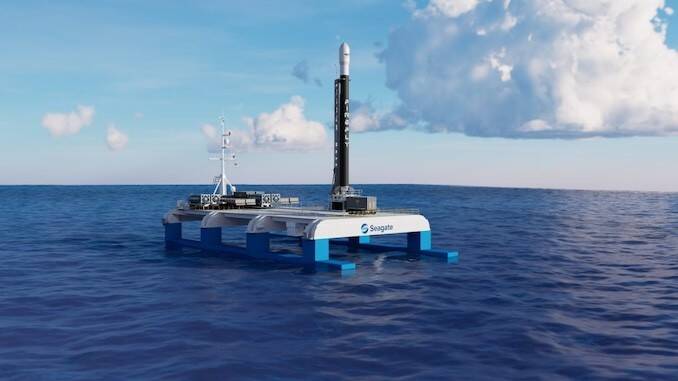
An artist’s interpretation of a Firefly Aerospace rocket atop a Seagate Space Gateway Series spaceport. Credit: Firefly Aerospace/Seagate Space
Jonathan Caldwell, vice president and general manager of Lockheed Martin’s Strategic and Missile Defense Systems division, revealed the company’s involvement in a May 4 announcement. He described the partnership as a blend of Lockheed’s long-standing expertise in national security and the innovative capabilities of newer space companies.
According to Caldwell, the three firms will collaborate on mission concepts and demonstration projects that utilize Seagate’s mobile offshore launch facility. This approach would allow launches from a wide range of ocean locations, offering greater operational flexibility and responsiveness—critical advantages for tactical payloads and defense-related missions.
Seagate Space had previously signed a memorandum of understanding with Firefly in April to develop offshore infrastructure tailored specifically for Alpha launches. The company’s Gateway Series platform is designed as a mobile spaceport, capable of supporting launch operations far from traditional terrestrial sites.
Sean Fortener, Seagate Space’s president and chief operating officer, emphasized that the platform is built for mobility, rapid response, and global accessibility—qualities that align closely with Firefly’s small-lift Alpha vehicle.
Lockheed Martin’s interest in the project is closely tied to evolving defense needs. Caldwell noted that a sea-based launch system could reduce reliance on congested ground facilities while enabling faster deployment of payloads. With over 70 percent of Earth’s surface covered by water, such a platform would also allow for more diverse launch trajectories and mission profiles.
The collaboration builds on an existing relationship between Lockheed Martin and Firefly. In December 2023, Firefly conducted its first mission for Lockheed, known as “Fly the Lightning,” which carried an electronically steered antenna payload aboard an Alpha rocket. Although the mission encountered a guidance software issue that prevented precise orbital insertion, the payload still achieved its primary objectives.
The partnership deepened in June 2024 when Lockheed Martin secured a 25-launch agreement with Firefly. While some early missions faced anomalies, Firefly has been advancing toward an upgraded Block 2 version of the Alpha rocket, with technology demonstrations already underway in 2026.
Beyond offshore ambitions, Firefly is also expanding its launch footprint globally. The company is developing new launch capabilities at the Mid-Atlantic Regional Spaceport in Virginia in partnership with Northrop Grumman, as well as at the Esrange Space Center in collaboration with SSC Space. While initial timelines aimed for operations by 2026, updated plans suggest launches supporting European defense needs could begin closer to 2028.
Add comment
Comments