

SpaceX successfully launched and deployed 45 satellites early Sunday morning in a complex international rideshare mission aboard its Falcon 9 rocket, marking another major milestone in the company’s growing launch operations. Liftoff took place at 12:00 a.m. PDT (3:00 a.m. EDT / 0700 UTC) from Space Launch Complex 4 East at Vandenberg Space Force Station in California. The mission, designated CAS500-2, was led by South Korea’s Compact Advanced Satellite 500-2, with SpaceX later confirming that all payloads were successfully deployed.
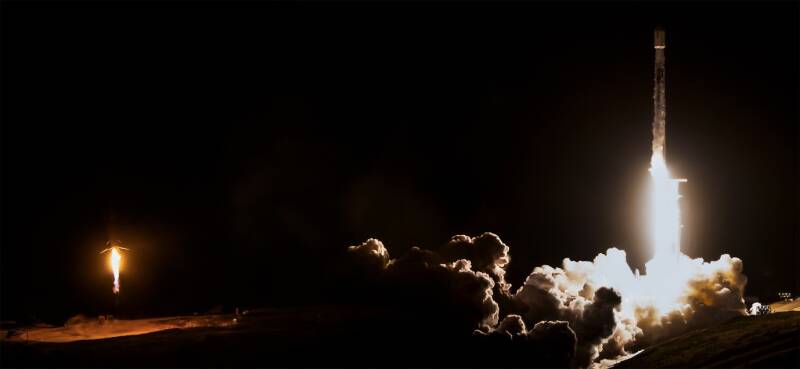
The primary payload, CAS500-2, is an Earth observation satellite developed by Korea Aerospace Industries (KAI). It represents the second spacecraft in Phase 1 of South Korea’s CAS500 program, which is designed to provide high-resolution imagery for precise ground monitoring. The satellite was deployed into a Sun-synchronous orbit roughly one hour after liftoff. The mission also underscored the strength of U.S.–South Korea cooperation in space, with Space Launch Delta 30 highlighting the importance of international partnerships in ensuring access to space and promoting stability in the Indo-Pacific region.
CAS500-2 experienced a long and complex path to launch. Originally scheduled to fly in 2022 aboard a Russian rocket, the mission faced delays due to geopolitical tensions following Russia’s war in Ukraine. Additional setbacks occurred when plans for a joint launch changed, ultimately leading to the satellite flying on a dedicated rideshare mission with SpaceX. Notably, this delay meant CAS500-2 launched after CAS500-3, which was sent into orbit aboard South Korea’s Nuri rocket in late 2025.
The Falcon 9 first-stage booster used for this mission, B1071, completed its 33rd flight, continuing SpaceX’s record-setting reuse of rocket hardware. The booster has previously supported a wide range of missions, including national security launches, NASA science missions, and numerous Starlink deployments. Less than seven and a half minutes after liftoff, B1071 successfully returned to Earth, landing at Landing Zone 4 near the launch site. This marked the 34th landing at that location and the 608th successful booster landing for SpaceX overall.
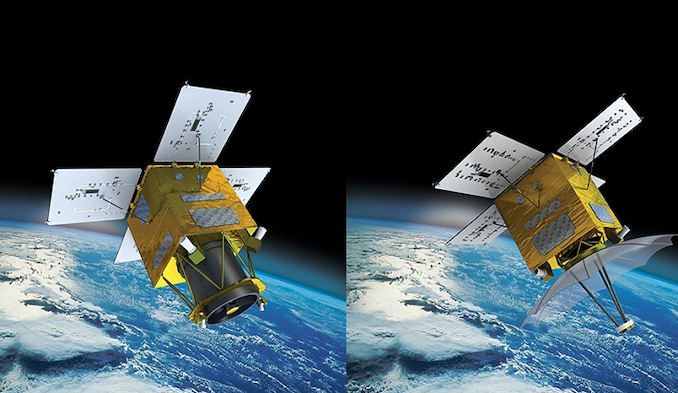
An artist’s rendering of the CAS500-1 and CAS500-2 satellites. Graphic: KARI
In addition to CAS500-2, the mission carried 44 secondary payloads from a wide array of international customers, highlighting the increasing demand for rideshare launch services. A significant portion of these satellites was managed by Exolaunch, which oversaw the deployment of dozens of CubeSats and MicroSats. The satellites were released in two carefully timed sequences, with the first group deployed a little over an hour after launch and the second batch released roughly two hours and twenty minutes into the mission. Exolaunch described the mission as a clear example of how it is scaling its operations to meet growing global demand for reliable access to orbit.
Several of the payloads contribute to expanding Earth observation capabilities. Italian company Argotec deployed seven satellites as part of the IRIDE constellation, a major initiative supported by the European Space Agency and involving more than 70 Italian companies. Meanwhile, Loft Orbital and EarthDaily Analytics launched six satellites that will form part of a larger constellation designed to deliver high-frequency, analysis-ready Earth data for governments and commercial industries.
The mission also included a variety of innovative spacecraft. Planet Labs added new Pelican Earth observation satellites to its growing fleet, while Lynk Global launched two satellites designed to enable direct-to-device connectivity from space. True Anomaly flew its fourth Jackal spacecraft, an autonomous orbital vehicle linked to future U.S. Space Force reconnaissance efforts. India’s GalaxEye also deployed its Mission Drishti satellite, described as the country’s largest privately built Earth observation spacecraft, featuring both radar and multi-spectral imaging capabilities.
With CAS500-2 now successfully in orbit, attention turns to the next phase of South Korea’s satellite program, including CAS500-4 and CAS500-5. Although these were previously expected to launch in 2025, updated timelines have yet to be announced.
Add comment
Comments