

Blue Origin encountered a setback in its push to scale up launch operations after its heavy-lift New Glenn rocket experienced a second-stage malfunction during its third flight on April 19, leaving its payload in an unintended orbit. The NG-3 mission lifted off at 7:25 a.m. Eastern from Launch Complex 36 at Cape Canaveral Space Force Station, following a brief hold in the countdown due to an unspecified technical issue. While the launch and ascent initially proceeded as planned, problems emerged during the upper stage phase of the mission.
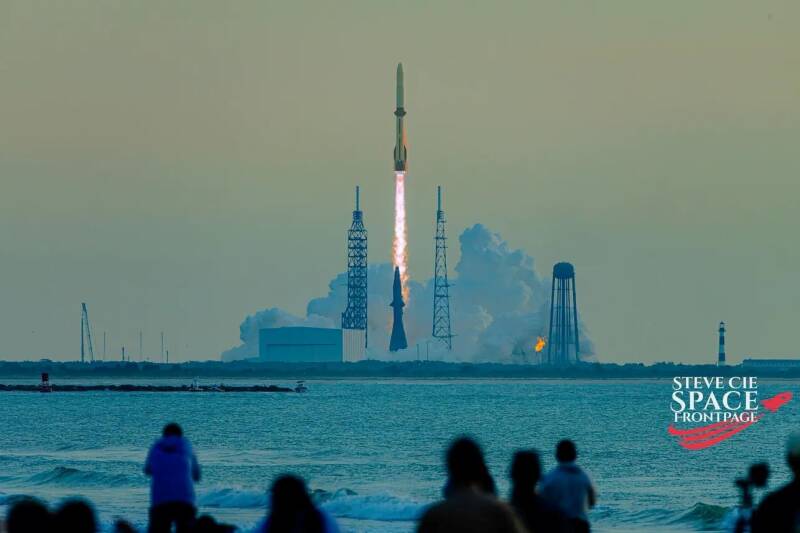
The rocket was carrying the BlueBird 7 communications satellite, built by AST SpaceMobile. The spacecraft was scheduled to separate roughly 75 minutes after liftoff into a 460-kilometer circular orbit inclined at 49.4 degrees. This deployment was to follow a second burn of the upper stage’s BE-3U engines.
However, Blue Origin ended its live webcast shortly after successfully recovering the rocket’s first stage, providing no immediate updates on the critical upper-stage burn or payload deployment. About an hour after the expected separation time, the company confirmed via social media that BlueBird 7 had deployed and powered on, but had been placed into an “off-nominal orbit.” The company said it is continuing to assess the situation.
Despite the upper-stage issue, the mission marked a milestone for Blue Origin with the first reflight of a New Glenn booster. The reusable first stage, named “Never Tell Me The Odds,” successfully landed on the company’s ocean-based platform, Jacklyn, approximately nine and a half minutes after liftoff. The same booster had previously flown during the NG-2 mission in November, which carried NASA’s ESCAPADE Mars mission.
That reuse, however, was only partial. Blue Origin replaced all seven BE-4 engines on the booster with new units for this flight, while also testing upgrades such as an enhanced thermal protection system. Company CEO Dave Limp noted ahead of launch that previously flown engines from NG-2 would be used on future missions.
Reusability remains central to Blue Origin’s strategy as it aims to increase launch cadence to meet growing demand from commercial customers like AST SpaceMobile. Company executives have emphasized ongoing investments in infrastructure, manufacturing, and engineering systems to support rapid scaling, though they have not disclosed specific launch targets for 2026.
The payload itself, BlueBird 7, is a massive 6,100-kilogram satellite equipped with a large phased-array antenna spanning more than 220 square meters when fully deployed. It is designed to deliver direct-to-device (D2D) broadband connectivity, allowing standard smartphones to connect directly to satellites without ground-based infrastructure.
AST SpaceMobile has ambitious plans for its constellation, aiming to deploy between 45 and 60 satellites this year. BlueBird 7 is the first satellite launch for the company since BlueBird 6, which was sent into orbit aboard an Indian LVM3 rocket in December.
Speaking in a March earnings call, AST SpaceMobile CEO Abel Avellan outlined plans to accelerate deployment by launching satellites in batches rather than individually. Future missions are expected to carry multiple spacecraft—ranging from three to eight per launch—in an effort to build out the constellation more efficiently.
The company is also counting on frequent New Glenn missions to support that cadence. Avellan indicated expectations that the reusable booster could support launches every 30 days or less, a pace that will depend heavily on resolving issues like the upper-stage anomaly seen on NG-3.
Add comment
Comments