

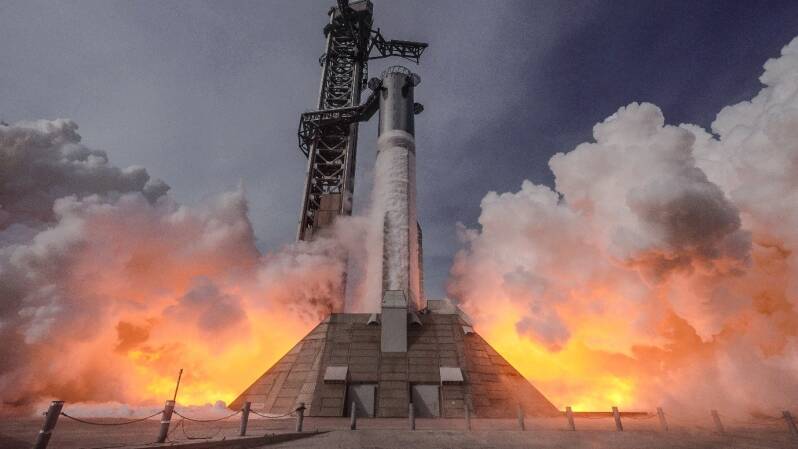
SpaceX has taken a significant step toward launching the next generation of its Starship megarocket, successfully completing a full-duration static-fire test of the upgraded “Version 3” upper stage. The test, conducted on the evening of April 14, saw the Starship V3 upper stage ignite its engines while secured to the launch pad—an essential preflight procedure used to validate performance and systems ahead of liftoff. In a brief statement posted on X, SpaceX confirmed the achievement, noting it was the first full-duration static fire for the new variant.
Credit: SpaceX
The milestone brings the company closer to Starship V3’s maiden flight, which is currently targeted for early to mid-May. The upcoming mission will mark the 12th overall Starship test flight, but the first for this significantly upgraded version of the vehicle.
The successful upper-stage test follows an earlier trial of the V3’s massive Super Heavy booster conducted about four weeks prior. That test involved firing 10 of the booster’s 33 Raptor engines but was cut short due to a ground equipment issue, highlighting the complexity of preparing the world’s most powerful rocket system for flight.
When fully assembled, Starship V3 stands an imposing 408.1 feet (124.4 meters) tall—roughly 4 feet taller than the previous Version 2 configuration. More importantly, it delivers a substantial leap in capability. Powered by newly developed Raptor V3 engines, the upgraded rocket is designed to carry more than 100 tons of payload to low Earth orbit, a dramatic increase from the approximately 35-ton capacity of its predecessor, according to SpaceX founder and CEO Elon Musk.
To date, Starship has completed 11 test flights, all suborbital, with the most recent occurring in October 2025. The last five of those missions utilized the V2 configuration, making the upcoming V3 launch a critical demonstration of the rocket’s next evolutionary step.
The development of Starship remains central to NASA’s long-term lunar ambitions. The agency has selected the vehicle as the first human-rated lunar lander for its Artemis program. Following the successful completion of Artemis 2 mission, which sent four astronauts around the Moon and safely back to Earth, attention is now shifting to more complex operations in orbit.
The upcoming Artemis 3 mission, currently slated for mid-2027, will test docking procedures in Earth orbit between NASA’s Orion spacecraft and one or more commercial lunar landers. These include Starship as well as Blue Origin’s Blue Moon lander, both of which are competing to play key roles in returning humans to the lunar surface.
If Artemis 3 proceeds as planned, NASA aims to follow it with Artemis 4, a mission targeted for late 2028 that would place astronauts near the Moon’s south pole—marking humanity’s first return to the lunar surface in more than half a century.
Add comment
Comments