

With the Artemis II launch just days away, NASA has unveiled an ambitious new strategy to establish a sustained human presence on the Moon, backed by a planned $20 billion investment over the next seven years.
The announcement, delivered Tuesday by NASA Administrator Jared Isaacman, outlines a sweeping vision centered on building a permanent lunar base near the Moon’s south pole. The proposed outpost will feature astronaut habitats, pressurized rovers, advanced communications networks and nuclear power systems capable of supporting continuous operations in one of the most extreme environments known.
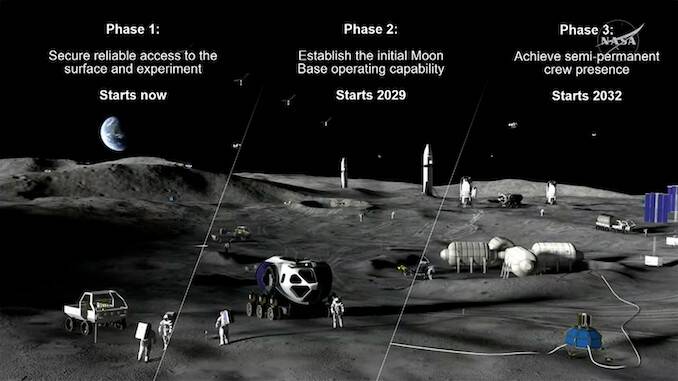
NASA plans to build a planned moon base in three stages, starting with more frequent astronaut and cargo flights to the moon the develop the infrastructure needed to support long-duration crews. Image: NASA TV
Isaacman framed the initiative as a decisive shift in NASA’s approach to lunar exploration, moving beyond symbolic missions toward long-term habitation. Drawing comparisons to the Apollo program, he said the agency aims to build operational experience through frequent, repeatable missions rather than isolated milestones. Unlike the Apollo era, he emphasized, the goal now is permanence.
Central to the revised Artemis architecture is a dramatic increase in mission cadence. NASA intends to work with multiple commercial providers to enable crewed lunar landings roughly every six months, marking a departure from reliance on the government-owned Space Launch System. Instead, the agency plans to lean more heavily on private-sector partners such as SpaceX and Blue Origin, reflecting a broader shift toward commercial collaboration in deep space exploration.
In a significant policy change, NASA will pause development of the Lunar Gateway, a long-planned orbital outpost around the Moon. Hardware and resources allocated to Gateway will instead be repurposed to support surface infrastructure for the lunar base. Under this new approach, astronauts traveling aboard Orion spacecraft will transfer directly to lunar landers without stopping at an orbital station, simplifying mission architecture while prioritizing surface operations.
The agency’s long-term ambitions extend well beyond the Moon. NASA officials highlighted ongoing work to develop nuclear power systems designed for both lunar and Martian environments. These systems are expected to provide reliable energy for habitats, research operations and life-support systems where solar power alone may be insufficient. The first major step in this direction will come with the planned “Skyfall” mission to Mars in 2028, which will deploy a fission reactor known as Space Reactor-1. The mission will also deliver a set of small aerial vehicles to scout potential landing sites, laying groundwork for future human exploration of the Red Planet.
Closer to Earth, NASA reaffirmed its commitment to maintaining a continuous human presence in low-Earth orbit after the retirement of the International Space Station in the early 2030s. However, officials acknowledged that efforts to stimulate private-sector development of commercial space stations have not progressed as quickly as hoped. In response, the agency is exploring new incentives, including expanded access for privately funded researchers and the possibility of allowing qualified non-astronauts to assume command roles on missions. NASA is also considering using the ISS as a staging platform for assembling commercial modules that could later operate independently.
Despite the scale of its ambitions, NASA leadership insists the plan can be executed within existing budget constraints. Isaacman argued that the agency’s challenge lies not in funding levels but in how resources are allocated. By repurposing existing hardware, streamlining operations and reducing inefficiencies, NASA believes it can support Artemis missions, nuclear technology development, scientific research and commercial partnerships simultaneously.
The construction of the lunar base itself will unfold gradually over multiple phases, beginning with an expansion of mission frequency and technology demonstrations. Early efforts will focus on testing mobility systems, power generation, communications and surface operations. This will be followed by the development of habitats and infrastructure to support regular astronaut stays, ultimately culminating in the establishment of permanent systems capable of sustaining a continuous human presence. These will include nuclear and solar power installations, fleets of crewed and uncrewed rovers, navigation networks similar to GPS and constellations of communication and observation satellites.
Isaacman stressed that the base will not be built overnight but will instead take shape through dozens of missions conducted in partnership with commercial companies and international collaborators. He described the Moon as a critical proving ground for technologies and operational strategies that will eventually enable human missions to Mars.
The renewed push also reflects growing geopolitical urgency. With other nations, particularly China, advancing their own lunar ambitions, NASA leadership signaled a determination to avoid further delays and cost overruns. Isaacman made clear that maintaining momentum is essential, warning that inefficiency and missed deadlines would not be tolerated as the agency works to secure a long-term foothold on the Moon.
Add comment
Comments