

The U.S. Space Force has reassigned the launch vehicle for its upcoming GPS III-8 satellite mission, opting to move the payload from United Launch Alliance’s Vulcan Centaur rocket to SpaceX’s Falcon 9. The decision comes as Vulcan undergoes an ongoing investigation into issues with its solid rocket boosters (SRBs).
Originally scheduled to fly aboard the Vulcan Centaur, the GPS III-8 mission will now launch atop a Falcon 9, reflecting what officials describe as a commitment to maintaining rapid and reliable deployment of critical navigation infrastructure.
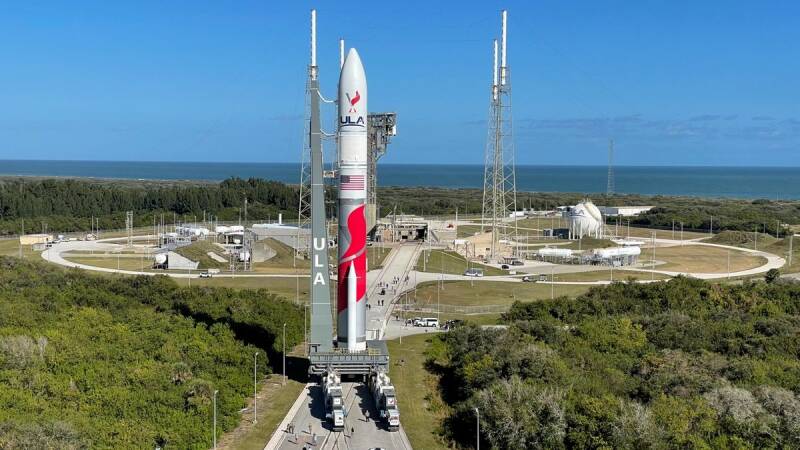
United Launch Alliance rolls its first Vulcan Centaur rocket to the launch pad on Jan. 5, 2024
“This adjustment ensures we continue delivering advanced GPS capabilities without delay while the Vulcan anomaly investigation proceeds,” said Ryan Hiserote, who leads launch programs at Space Systems Command. He emphasized the Space Force’s ability to remain flexible and leverage multiple launch providers to meet national security needs.
The Vulcan Centaur rocket, developed by United Launch Alliance as the successor to the long-serving Atlas V, first launched in January 2024 and has since completed three additional missions. However, anomalies involving its solid rocket boosters were observed during two of those flights—one in October 2024 during a national security certification mission, and another on the USSF-87 mission earlier this year.
Although both missions ultimately reached orbit successfully, the recurring issues prompted concern within the Space Force. In late February, officials announced a temporary suspension of Vulcan’s national security launches pending the outcome of a detailed investigation.
Against this backdrop, the reassignment of the GPS III-8 mission was widely anticipated. The satellite, which represents the 10th and final spacecraft in the GPS III series, is now slated for launch no earlier than late April from Space Launch Complex-40 at Cape Canaveral Space Force Station in Florida.
In a reciprocal adjustment, Vulcan Centaur is now expected to take over the USSF-70 mission—previously assigned to SpaceX’s Falcon Heavy. That launch is currently targeted for no earlier than summer 2028.
Despite the temporary setback, United Launch Alliance is expected to prioritize resolving the booster anomalies quickly. The Space Force remains one of Vulcan’s primary customers, with more than two dozen future missions already booked on the rocket over the coming years.
The reshuffling underscores the increasing importance of flexibility in the U.S. military’s launch strategy, as it balances reliability concerns with the urgent need to deploy next-generation satellite systems.
Add comment
Comments