

NASA is preparing to once again fully fuel its towering Space Launch System rocket in a critical launch countdown rehearsal this week, as the agency works toward clearing the path for the Artemis II mission to carry astronauts around the Moon.
The upcoming operation — known as a wet dress rehearsal (WDR) — will begin with a call to stations inside Firing Room 1 at the Launch Control Center at Kennedy Space Center at 6:40 p.m. EST (2340 UTC) on Tuesday, Feb. 17. The test will culminate Thursday evening, Feb. 19, when engineers aim to load more than 700,000 gallons of supercold liquid hydrogen and liquid oxygen into the rocket and simulate a launch countdown down to a planned T-0 of 8:30 p.m. EST (0130 UTC).
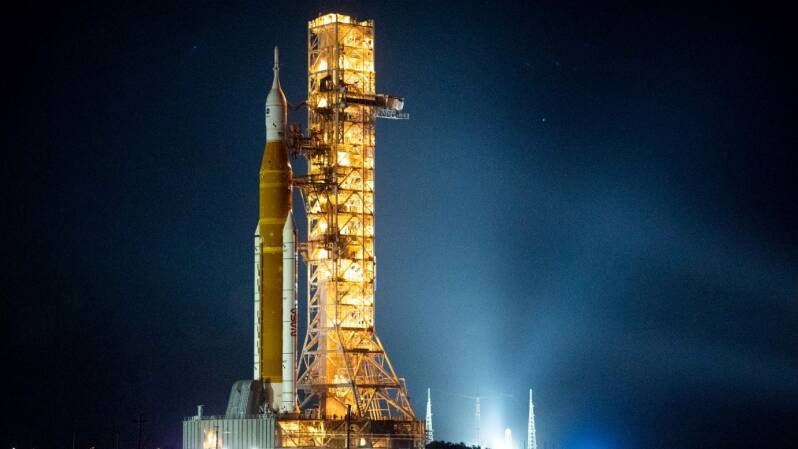
NASA's Space Launch System (SLS) rocket with the Orion spacecraft aboard is seen atop the mobile launcher as it rolls out of the Vehicle Assembly Building to Launch Pad 39B at NASAs Kennedy Space Center on November 3, 2022 in Cape Canaveral, Florida. Credit: Joel Kowsky/NASA
The second full-length fueling attempt comes just days after NASA conducted what it described as a “confidence test” on Feb. 12. During that shorter operation, teams partially loaded liquid hydrogen into the rocket’s massive core stage to evaluate newly replaced seals in a critical propellant feed interface. The seals are located in the Tail Service Mast Umbilical, the ground-to-rocket connection point that delivers liquid hydrogen to the vehicle.
According to NASA, the Feb. 12 test successfully gathered key engineering data, particularly from the core stage interface that had experienced leaks during the first wet dress rehearsal earlier this month. However, a separate issue with ground support equipment reduced the flow rate of liquid hydrogen into the rocket, limiting the scope of the test.
NASA Administrator Jared Isaacman said the seal repairs performed after the initial WDR yielded measurable improvements. “We observed materially lower leak rates compared to prior observations,” he wrote on social media, emphasizing that the test concluded not because of a failure, but because engineers had obtained sufficient data to move forward.
The first full wet dress rehearsal, which wrapped up Feb. 3, was halted after teams encountered hydrogen leaks while transitioning from slow-fill to fast-fill operations of the core stage. Liquid hydrogen, chilled to minus 423 degrees Fahrenheit, is notoriously difficult to manage due to its small molecular size and extreme flammability. During tank pressurization in the terminal count phase, hydrogen concentrations exceeded NASA’s strict 16 percent safety threshold, forcing controllers to stop the countdown at T-5 minutes and 15 seconds.
For Artemis launch director Charlie Blackwell-Thompson, the early cutoff meant several key objectives went unmet. Engineers had planned to hold the countdown inside the terminal count to demonstrate the rocket’s ability to maintain launch-ready cryogenic conditions for up to three minutes. They also intended to rehearse a recycle — resetting the clock within the launch window and targeting a new liftoff time — before handing control over to the automated launch sequencer.
Those missed milestones are central to the objectives for the upcoming WDR-2. Controllers plan to bring the countdown to T-1 minute and 30 seconds, enter a three-minute hold, proceed to T-33 seconds, and then pause again. Afterward, they will recycle the clock back to T-10 minutes and conduct another terminal count run, simulating the type of real-time adjustments that could be required on launch day.
As with the first rehearsal, NASA’s closeout crew — responsible for final pad operations before liftoff — will also practice their launch-day procedures, even though the Artemis II astronauts will not be aboard during the test. Agency officials had briefly considered excluding the closeout team from the second rehearsal but ultimately opted to include them to maximize realism.
NASA leadership has repeatedly stressed that a firm launch date will not be set until a full and successful wet dress rehearsal campaign is completed. While March 6 remains the earliest available date in the current launch window, agency officials caution that the schedule hinges entirely on technical readiness.
“There is still a great deal of work ahead to prepare for this historic mission,” Isaacman said. “We will not launch unless we are ready and the safety of our astronauts will remain the highest priority.”
Artemis II is intended to send four astronauts on a roughly 10-day mission around the Moon — the first crewed lunar flight since the Apollo era — serving as a critical proving ground before a future landing mission later in the decade.
Add comment
Comments