

Blue Origin is set to take a major step forward in orbital rocket reusability with the next flight of its heavy-lift New Glenn vehicle.
The company announced Thursday, Jan. 22, that its upcoming NG-3 mission — targeted for late February — will carry one of AST SpaceMobile’s massive Block 2 BlueBird satellites to low Earth orbit. The launch will mark the third flight of New Glenn and, crucially, the first time the rocket flies with a previously used first-stage booster.
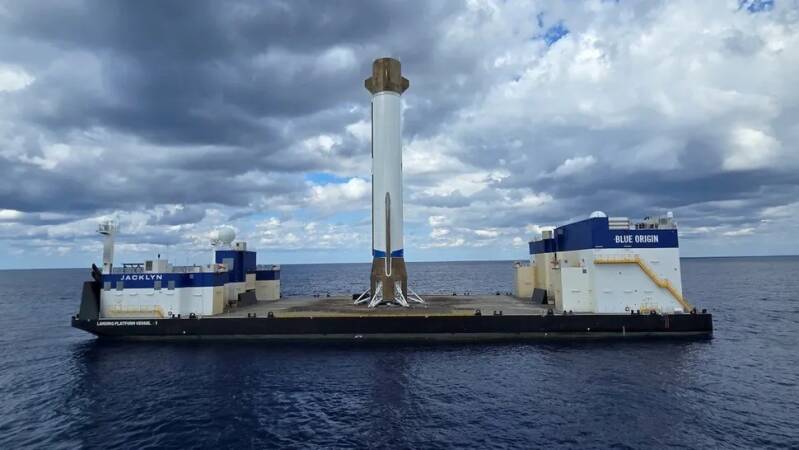
New Glenn's booster after its successful landing. Credit: Blue Origin
According to Blue Origin, the NG-3 mission will reuse the booster that flew on New Glenn’s second launch, NG-2, which successfully sent NASA’s twin ESCAPADE spacecraft toward Mars on Nov. 13. That mission also marked New Glenn’s first successful booster recovery, with the first stage touching down intact on the company’s drone ship Jacklyn in the Atlantic Ocean.
Standing 322 feet (98 meters) tall, the two-stage New Glenn ranks among the largest rockets ever built. Its first stage was designed from the outset for extensive reuse, with Blue Origin targeting at least 25 flights per booster as it works to lower launch costs and increase flight cadence.
New Glenn made its orbital debut in January 2025, when it successfully placed a test version of Blue Origin’s Blue Ring spacecraft into orbit. That first mission ended with a failed booster landing attempt. The follow-on NG-2 flight, however, demonstrated the system’s recovery capability — setting the stage for reflight just months later.
The NG-3 mission will once again lift off from Cape Canaveral Space Force Station, delivering a Block 2 BlueBird satellite into low Earth orbit. The spacecraft will contribute to AST SpaceMobile’s growing direct-to-cellphone broadband constellation, which aims to provide space-based connectivity directly to standard mobile devices without the need for specialized hardware.
Block 2 BlueBird satellites are among the largest commercial communications spacecraft ever deployed, featuring antennas spanning roughly 2,400 square feet (223 square meters). To date, only one Block 2 BlueBird has reached orbit, launched atop an Indian rocket in December. AST SpaceMobile has also deployed five first-generation BlueBird satellites, each equipped with smaller 693-square-foot (64.4-square-meter) communication arrays.
“We’re proud to have AST SpaceMobile as our customer on NG-3,” Blue Origin CEO Dave Limp said in a statement. “Our customers need a reliable, cost-effective launch vehicle, and New Glenn is purpose-built to serve their needs.”
While the upcoming mission represents Blue Origin’s first reuse of an orbital-class booster, the company brings significant experience with reusability from its New Shepard program. New Shepard has been flying reusable rocket-capsule missions to suborbital space since 2015 and has completed 38 flights to date, including 17 carrying space tourists. Its most recent crewed mission flew on Thursday.
With New Glenn, Blue Origin is now entering territory long dominated by SpaceX, whose Falcon 9 rocket pioneered routine recovery and reuse of orbital boosters. SpaceX achieved its first such landing in December 2015 and has since recorded more than 500 booster recoveries, under the leadership of founder Elon Musk.
If NG-3 performs as planned, the mission will represent a milestone not only for Blue Origin but also for the broader commercial launch market, signaling that reusable heavy-lift rockets beyond SpaceX are beginning to mature into regular operational service.
Add comment
Comments