

The U.S. Space Force is once again reshuffling launch assignments for its Global Positioning System constellation, shifting the next GPS satellite mission from United Launch Alliance to SpaceX in an effort to accelerate delivery and reduce costs. A spokesperson for the Space Force’s Space Systems Command confirmed Tuesday that the GPS III Space Vehicle 09 (SV09) will now launch aboard a SpaceX Falcon 9 rocket instead of ULA’s Vulcan.
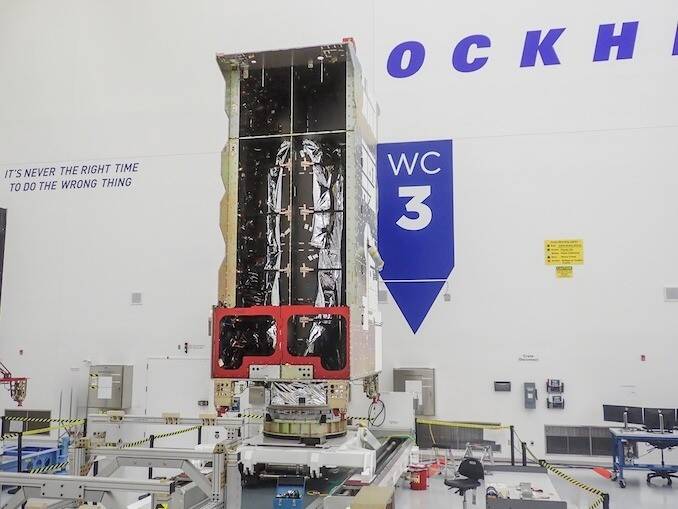
The GPS IIIF Space Vehicle 13 satellite seen in early 2025 inside a Lockheed Martin clean room in Denver, CO, as it goes through the process known as “core mate.” That’s where the equipment panels containing the major electronics for the satellite bus and payload are mated with the propulsion core and subsystems. Image: Lockheed Martin
The change could see SV09 reach orbit within the next few weeks, as the satellite has entered the final phases of pre-flight processing. Under the revised plan, United Launch Alliance will take on a different GPS mission, launching the GPS III Follow-on (GPS IIIF) Space Vehicle 13 (SV13) on Vulcan. SV13 had previously been assigned to fly on a Falcon Heavy rocket at a later, unspecified date.
According to the Space Force, the decision mirrors earlier mission swaps aimed at getting critical capabilities on orbit as quickly as possible. “SV09 and SV13 were traded between ULA and SpaceX to get capability to orbit as soon as possible, for the same reason as the prior swap, which resulted in the last GPS launch in May 2025,” the spokesperson said. “The trade results in an overall net cost savings to the government and again demonstrates our sustained commitment to moving at speed to deliver combat-credible capabilities on orbit to meet warfighter needs.”
SV09 was originally awarded to United Launch Alliance as part of order year five of the National Security Space Launch (NSSL) Phase 2 contract, announced on Oct. 31, 2023. Under that award, ULA received 11 missions valued at approximately $1.3 billion, including the GPS III-9 mission that would have carried SV09 to orbit. SV13, by contrast, was initially slated to launch on a Falcon Heavy rocket in a future calendar year after being awarded to SpaceX under the first order year of the NSSL Phase 3 Lane 2 contract announced on April 7, 2025.
This latest adjustment continues a pattern of flexibility by the Space Force as it manages launch schedules amid evolving vehicle readiness and mission priorities. In May 2025, SpaceX launched the GPS III SV08 satellite, a mission that had originally been assigned to ULA in June 2023. In exchange, ULA was awarded the SV11 launch, which would have otherwise flown on a Falcon Heavy rocket.
A similar move occurred in December 2024, when SpaceX launched the GPS III SV07 spacecraft under a mission dubbed Rapid Response Trailblazer. That satellite had also been originally assigned to ULA, but was reassigned to SpaceX to offset delays in Vulcan’s availability. At the time, Col. Doug Pentecost, then deputy program executive officer for Space Systems Command’s Assured Access to Space program, said the goal was to minimize the impact of launch vehicle delays on the Space Force’s manifest.
Together, these swaps underscore the Space Force’s increasing willingness to dynamically reassign missions between launch providers to maintain constellation health and operational readiness. By leveraging multiple certified launch systems and adjusting contracts when necessary, Space Systems Command aims to ensure continuous, resilient GPS coverage while controlling costs and keeping pace with national security requirements.
Add comment
Comments