

Firefly Aerospace has unveiled a significant Block II configuration upgrade for its Alpha small launch vehicle, marking the next phase in the company’s effort to improve reliability, manufacturing efficiency, and operational flexibility as competition intensifies in the global smallsat launch market. Qualification testing of the new second-stage hardware is already underway at Firefly’s Rocket Ranch test facility in Briggs, Texas, laying the groundwork for the upgraded vehicle’s first full flight later this year.
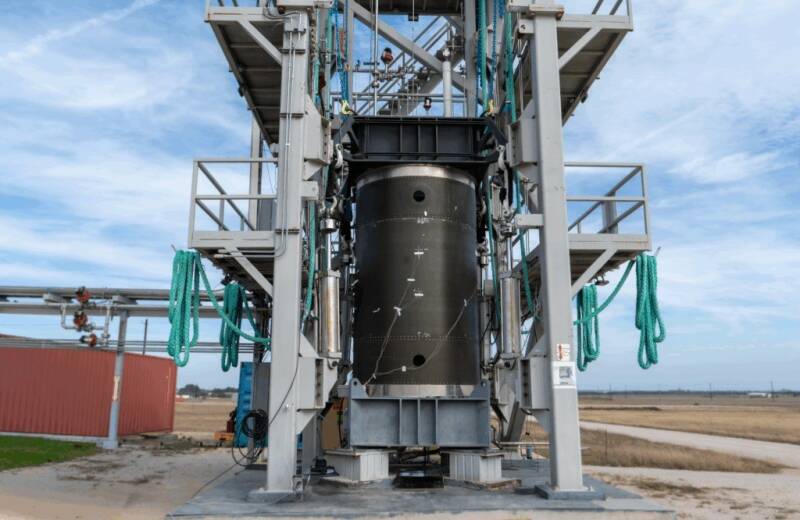
Block II upgrade designed to increase reliability and expand Alpha’s capability to support responsive launches across the globe; Qualification testing underway for Block II second stage hardware for Alpha Flight 8 at Firefly’s Rocket Ranch in Briggs, Texas
The upcoming Alpha Flight 7 mission, targeted to launch in the coming weeks, will serve as the final flight of the current Block I configuration. Rather than a clean break, Firefly is using Flight 7 as a pathfinder mission, flying several Block II subsystems in “shadow mode.” This approach allows engineers to gather real flight data and validate design improvements without committing to the full Block II stack. The complete Block II configuration is expected to debut on Alpha Flight 8.
According to Firefly chief executive Jason Kim, the Block II effort is a natural extension of the company’s long-term growth strategy. He said the upgrade reflects Firefly’s culture of continuous improvement, with a strong emphasis on safety, quality, and reliability. The design changes draw on lessons learned from the first six Alpha launches and hundreds of hardware tests, enabling the company to refine the vehicle while preserving its proven foundation.
Engineering work on Block II has focused heavily on manufacturability and consistency. Firefly has consolidated parts, updated key configurations, and reinforced structures using automated production tools, aiming to streamline assembly and improve repeatability. The goal is to evolve Alpha into a more responsive and rapidly producible launcher capable of meeting the needs of commercial operators, civil agencies, and national security customers.
Beyond production improvements, Block II is designed to expand Alpha’s mission envelope, particularly for time-sensitive and high-value launches. Firefly has highlighted applications ranging from hypersonic testing to national security missions, including support for programs such as Golden Dome, as well as commercial satellite deployments for domestic and international customers seeking flexible access to orbit.
One of the most visible changes in the Block II configuration is an increase in vehicle length and overall structural robustness. Alpha will grow from roughly 97 feet to about 104 feet tall. The rocket’s carbon composite structures have been optimized for rapid fabrication using Firefly’s Automated Fiber Placement machine and strengthened to handle higher loads, all while retaining the vehicle’s core architectural design.
Block II also introduces a shift away from off-the-shelf components in favor of consolidated, in-house systems. Firefly is transitioning to a unified power and avionics suite developed internally and shared across its launch vehicles and spacecraft. This move is expected to improve schedule control, boost reliability, and simplify logistics and maintenance by reducing supplier dependencies and part variability.
Updates extend to the propellant tanks and thermal protection system as well. The Block II Alpha features an improved thermal protection system for added robustness and re-optimized liquid oxygen and RP-1 tank configurations. These changes are designed to extend stage burn time and support more demanding mission profiles, including higher-energy orbits.
Several of these upgrades will be exercised on Alpha Flight 7 despite it remaining a Block I mission overall. Firefly has already delivered the first stage for Flight 7 to Vandenberg Space Force Base, where teams are integrating it with the second stage and payload fairing ahead of a static fire test and launch.
Firefly vice president of launch Adam Oakes said the phased rollout strategy allows the company to accelerate the Block II schedule while validating mass savings, production optimizations, and reliability improvements across the Alpha vehicle. By incrementally introducing new systems, Firefly aims to reduce risk ahead of the full Block II debut.
Despite the configuration changes, Firefly emphasized that Alpha’s core technologies remain intact. The flight-proven Reaver engines on the first stage, the Lightning engine on the second stage, and the rocket’s carbon composite primary structures continue to form the backbone of the vehicle, ensuring continuity as incremental refinements are introduced.
Firefly is positioning Alpha Block II as a key element of a broader portfolio that spans small- to medium-lift launch vehicles, lunar landers, and orbital platforms built around common, flight-proven technologies. The company says this shared approach allows it to deliver speed, reliability, and cost efficiency across missions ranging from low Earth orbit to lunar operations.
The company also underscored its role in enabling responsive space services, particularly for government customers. Firefly has previously highlighted its ability to launch a satellite with as little as 24 hours’ notice and to execute precision lunar missions. With engineering, manufacturing, and test facilities co-located in central Texas, Firefly believes it is well positioned to rapidly iterate designs, integrate testing, and deploy upgraded systems such as Alpha Block II at an accelerated pace.
Add comment
Comments