

South Korea’s newest Earth-observation spacecraft, KOMPSAT-7, safely reached a Sun-synchronous orbit on Monday afternoon following a smooth launch aboard Arianespace’s Vega-C rocket. The mission lifted off from Europe’s Spaceport in French Guiana, marking another milestone in Seoul’s expanding ambitions in space-based imaging and reconnaissance.
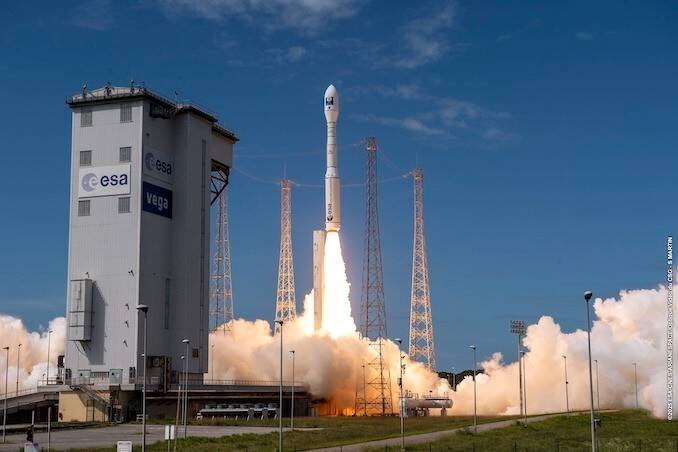
Arianespace Vega-C rocket lifts off from Europe’s Spaceport in Kourou, French Guiana, on Dec. 1, 2025, carrying South Korea’s KOMPSAT-7 satellite. Image: ESA
The 35-meter-tall Vega-C rocket thundered away from the launch pad under the thrust of its P120C solid rocket motor. After a 44-minute ascent, the launcher deployed the KOrea Multi-Purpose SATellite-7 into a 576-kilometre-high Sun-synchronous orbit, positioning it for precision Earth-observation duties.
“Arianespace is proud to support an ambitious national space program,” said CEO David Cavaillolès after the successful deployment. “KOMPSAT-7 will significantly enhance South Korea’s Earth-observation capabilities.” This mission represents the fourth KARI satellite launched by Arianespace.
Roughly one hour and nine minutes after separation, the Korea Aerospace Research Institute confirmed that ground controllers had established contact with the spacecraft via the Troll Satellite Station in Antarctica.
KOMPSAT-7 succeeds KOMPSAT-3A, launched in 2015 aboard a Dnepr rocket, and carries major technological upgrades. The satellite is equipped with KARI’s Advanced Earth Imaging Sensor System – High Resolution (AEISS-HR), designed to deliver ultra-high-resolution optical imagery. For the first time on a Korean satellite, KOMPSAT-7 incorporates a control moment gyroscope, providing enhanced agility and improved pointing precision. Its onboard computer is also more than three times faster than that of its predecessors, significantly improving attitude control and operational efficiency.
According to KARI, its upgraded ground processing system utilizes advanced parallel computing to perform first-stage geometric correction and produce usable imagery within 15 minutes of receiving raw data.
KARI stated in a Facebook update that KOMPSAT-7 is expected to begin supplying operational Earth-observation imagery in the first half of 2026.
Monday’s mission marked the sixth flight of the Vega-C rocket and Arianespace’s sixth launch of 2025, underscoring the company’s continued role in enabling global Earth-observation and scientific missions.
Add comment
Comments