

A German astronaut will become the first European to travel to the Moon under NASA’s Artemis program, the European Space Agency (ESA) announced on Thursday during its high-level Ministerial Council meeting in Bremen. The decision marks a historic milestone for Europe’s human spaceflight ambitions, made possible by major European contributions to lunar exploration hardware.
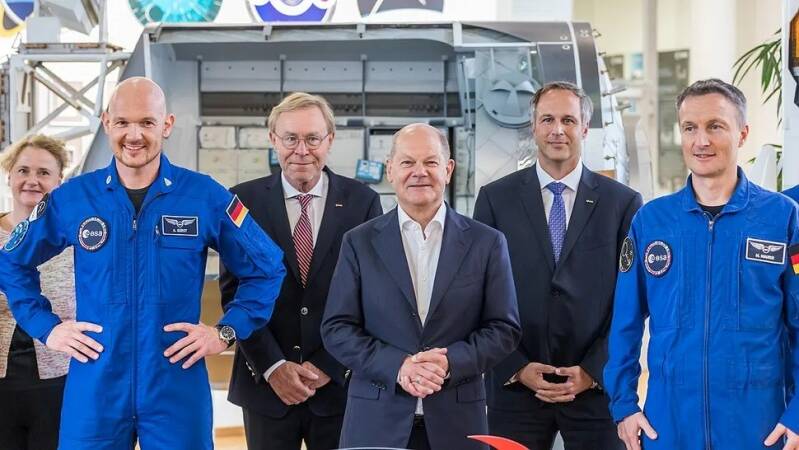
(Left to right): Astronaut Alexander Gerst, Chancellor Olaf Scholz, astronaut Matthias Maurer at the EAC (European Astronaut Centre) of the ESA. Credit: Raimond Spekking via Wikimedia Commons
ESA Director General Josef Aschbacher confirmed that Europe has secured three astronaut seats on upcoming Artemis missions in exchange for its extensive support for NASA’s lunar program. Germany, as the agency’s largest financial contributor, will claim the first of those seats on the Artemis 4 mission, slated for the second half of 2028.
Germany’s central role in Europe’s lunar infrastructure significantly strengthened its claim. In Bremen, Airbus assembles the European Service Module (ESM), the power- and propulsion-providing segment of NASA’s Orion spacecraft. Europe is also building key elements of the Lunar Gateway — the future space station that will orbit the Moon beginning in 2027 — via industrial teams led by France and Italy. Citizens from those countries are expected to fly on Artemis 5 and later missions.
“An ESA astronaut traveling beyond low Earth orbit for the first time will be a huge inspiration and a source of pride for their country and for Europe at large,” Aschbacher said.
ESA’s astronaut corps currently includes two veteran German astronauts: Alexander Gerst, 49, and Matthias Maurer, 55. Both have previously completed long-duration missions aboard the International Space Station (ISS), making them front-runners for the coveted lunar-orbit assignment.
Gerst, who logged 362 days in space and served as ISS commander in 2018, is one of Europe’s most seasoned spacefarers. Maurer, who spent 176 days in orbit in 2021 and performed a spacewalk during his mission, remains a strong contender as well. Germany’s two reserve astronauts — Amelie Schoenenwald and Nicola Winter — have yet to fly.
Though European astronauts have traveled to the ISS and even serviced the Hubble Space Telescope, none has ever ventured beyond low Earth orbit. That will change with Artemis 4.
“We can now, for the very first time, send a European astronaut flying 360,000 kilometers away,” said Dorothee Bär, Germany’s Federal Minister of Research, Technology and Space. “It will take three days before he sees the Earth as a whole — something no European has witnessed.”
Future European Moonwalkers Likely French or Italian
While Germany will supply the first European astronaut to orbit the Moon, the first European moonwalker will likely be French or Italian, Aschbacher said.
France’s Thomas Pesquet, 47, widely regarded as a leading candidate, has accumulated 397 days in space across two ISS missions and conducted multiple spacewalks. Fellow French astronaut Sophie Adenot, selected in 2022, will gain long-duration experience during her eight-month ISS mission next year, potentially positioning her for future lunar assignments.
Italy’s top contenders include veterans Luca Parmitano — known for surviving a dangerous spacewalk in 2013 when his helmet flooded — and Samantha Cristoforetti, both of whom have flown twice to the ISS.
Artemis Timeline and Uncertainty Beyond 2030
NASA has already named the crew for Artemis 2, which will return astronauts to lunar orbit in 2026. Artemis 3, targeting a 2027 Moon landing, is not expected to include a European astronaut. Europe’s seats are confirmed for Artemis 4 (2028) and Artemis 5 (2030).
Artemis 6, planned for no earlier than 2031, faces an uncertain future. The Trump administration has indicated it intends to phase out NASA’s Space Launch System (SLS) rocket and the Orion spacecraft in favor of commercially developed vehicles. ESA currently has agreements to supply six European Service Modules but hopes to remain involved beyond that number.
“Beyond European Service Module number six, we want to keep the options open,” said Daniel Neuenschwander, ESA’s Director for Human and Robotic Exploration. “The U.S. partner may still come to us for continuation.”
Alongside its Orion contributions, ESA is developing the Argonaut lunar cargo lander, which could serve as a negotiating asset for future seats on Moon missions.
Add comment
Comments