

A United Launch Alliance (ULA) Atlas V rocket successfully launched its heaviest-ever payload early Saturday morning, marking a significant milestone in the growing race to build global satellite internet networks. The Atlas V lifted off at 1:46 a.m. EDT (0546 GMT) on April 4 from Cape Canaveral Space Force Station in Florida. Riding atop the rocket were 29 satellites destined for Amazon’s low Earth orbit broadband constellation, now known as Amazon Leo.
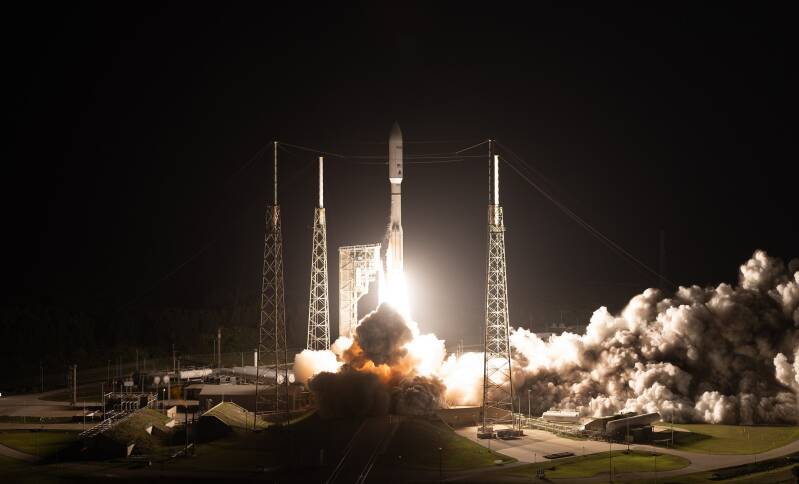
Credit ULA
According to ULA, the combined weight of the satellites reached approximately 18 tons, making it the heaviest payload ever carried by an Atlas V rocket. The mission concluded successfully, with all 29 satellites deployed into their intended orbit.
Amazon Leo—previously called Project Kuiper—is the company’s ambitious effort to establish a global satellite internet network. The constellation is expected to eventually include around 3,200 satellites, providing broadband coverage worldwide. It is widely seen as a direct competitor to SpaceX’s Starlink system, which already operates a fleet of more than 10,000 satellites in orbit.
Despite its scale, Amazon Leo remains in its early deployment phase. To date, 241 satellites have been placed in orbit across nine launches, excluding a 2023 mission that carried only two prototype spacecraft.
Saturday’s mission, designated LA-05 by Amazon, marked a notable advancement in launch capability. It was the first Atlas V flight to carry 29 Amazon Leo satellites, surpassing previous missions that deployed 27 each. The increase in payload capacity was made possible through collaborative engineering improvements between Amazon and ULA.
Central to this enhancement is a higher-performing version of the RL10C engine used on the Atlas V’s Centaur upper stage. While the engine itself has flown before, LA-05 represents the first time it has been fully certified—following extensive engineering and safety analysis—to handle a larger payload configuration.
ULA has now conducted five operational launches for the Amazon Leo program. Other missions have utilized Falcon 9 rockets from SpaceX and Arianespace’s Ariane 6. Together, these efforts underscore the increasing collaboration—and competition—among global launch providers in deploying next-generation satellite constellations.
Add comment
Comments