

United Launch Alliance has returned to operating on both U.S. coasts at the same time, staging Vulcan launch vehicles at pads in California and Florida for the first time since late 2022—a milestone in the company’s transition away from Atlas-era operations and toward a higher-cadence Vulcan manifest.
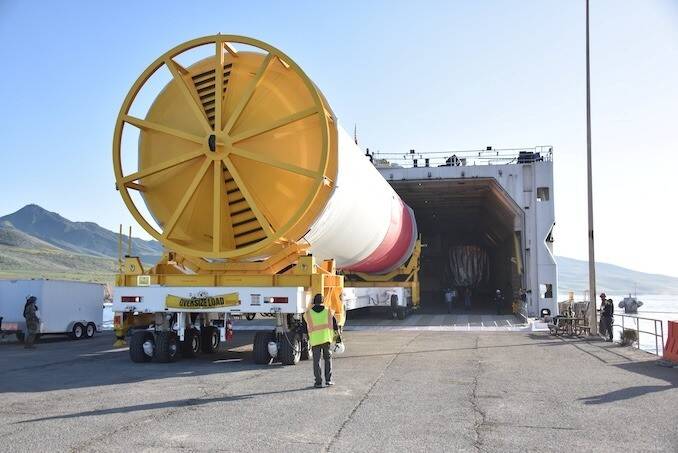
United Launch Alliance Vulcan booster is offloaded from the company’s R/S RocketShip barge at a dock at Vandenberg Space Force Base in California. This will be the first Vulcan rocket to launch from the West Coast. Image: ULA
On Tuesday, ULA confirmed the arrival of its transport barge, the R/S RocketShip, at a port inside Vandenberg Space Force Base. The vessel offloaded the booster and upper stages for the first Vulcan rocket slated to fly from the West Coast. The barge had departed ULA’s Decatur, Alabama, manufacturing facility in December, stopped at Port Canaveral, Florida, and then transited to California in early January.
According to the U.S. Space Force’s System Delta 80, the first planned Vulcan mission from Space Launch Complex 3 (SLC-3) at Vandenberg is currently the Space Development Agency’s T1TR-B (Tranche 1 Tracking Layer B) mission for the Space Development Agency. Officials cautioned, however, that the launch manifest remains fluid and subject to change.
While hardware was arriving in California, Vulcan processing continued on the opposite coast. On Wednesday, inside the Vertical Integration Facility at Cape Canaveral Space Force Station’s Space Launch Complex 41, ULA lifted the payload stack for the USSF-87 mission atop a separate Vulcan rocket.
The primary payload for USSF-87 is a Geosynchronous Space Situational Awareness Program (GSSAP) spacecraft built by Northrop Grumman. The satellite will deploy into geosynchronous orbit using an ascending node injection, improving the U.S. Space Force’s ability to detect, characterize, and attribute disturbances affecting satellites in the GEO belt. Flying alongside it is a propulsive ESPA (EELV Secondary Payload Adapter) carrying multiple secondary payloads.
System Delta 80 described those secondary spacecraft as research, development, and training systems designed to help United States Space Force Guardians refine tactics for precise on-orbit maneuvers and to enhance resiliency and protection in geosynchronous orbit.
ULA is targeting the USSF-87 launch for no earlier than February 12. As is standard for national security missions, an exact liftoff time will be announced closer to launch.
The renewed two-coast posture follows more than two years of work to reestablish ULA’s West Coast capability after its final Atlas V launch from SLC-3 on Nov. 10, 2022. That mission carried NOAA’s JPSS-2 weather satellite for the National Oceanic and Atmospheric Administration, along with NASA and ULA’s LOFTID inflatable heat shield demonstrator for NASA.
Following that flight, ULA began converting SLC-3 from an Atlas V configuration to one tailored for Vulcan. The effort faced supply-chain challenges, according to company leadership at the time, but progressed steadily. Preparations included dredging the Vandenberg harbor to allow the RocketShip barge to safely offload flight hardware.
Operations at SLC-3 will also differ from Florida. Whereas Vulcan rolls to the pad from the VIF at SLC-41, the California site employs a Mobile Service Tower that will retract from the rocket ahead of launch.
With Vulcan vehicles now being processed simultaneously in California and Florida, ULA is signaling that its next-generation rocket is moving toward routine operations—restoring the company’s ability to serve both polar and equatorial orbits from opposite coasts as national security demand ramps up.
Add comment
Comments