

SpaceX has issued a temporary "pause" on all Falcon 9 launches following an engine malfunction at the conclusion of a Starlink mission on Monday, February 2. While the rocket successfully delivered its payload of 25 satellites to their intended orbit, the vehicle's upper stage experienced an "off-nominal condition" during a critical deorbit maneuver, raising concerns about orbital safety and hardware reliability.
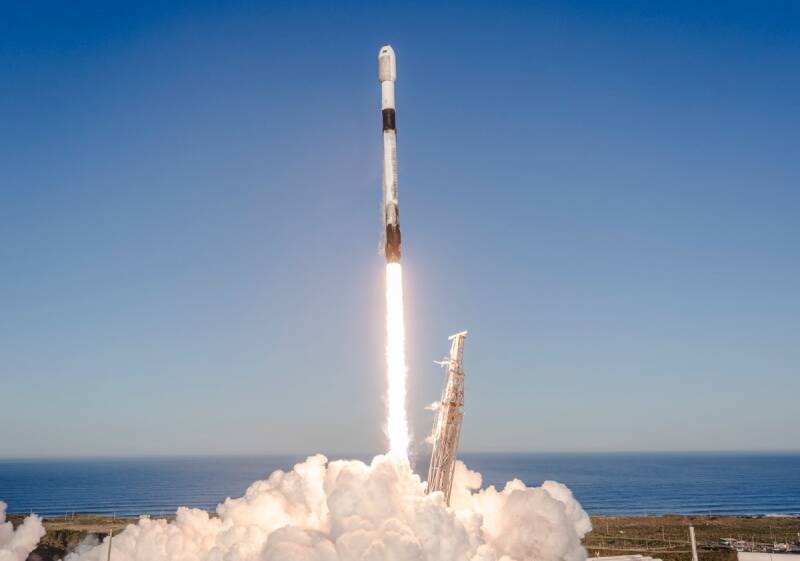
A Falcon 9 lifts off from Vandenberg Space Force Base Credit: SpaceX
The mission began routinely at 10:47 a.m. EST as the Falcon 9 lifted off from Vandenberg Space Force Base in California. For the first hour of flight, the mission appeared nominal: the booster successfully separated and landed on a droneship, and the second stage performed two burns of its single Merlin engine to deploy the Starlink satellites.
However, approximately nine hours after liftoff, SpaceX confirmed that the upper stage failed to perform its final deorbit burn. This maneuver is vital for space sustainability, as it forces the spent stage to reenter the atmosphere and burn up over a designated unpopulated area, typically the South Pacific. Instead, the vehicle performed a "passivation" sequence—venting fuel and discharging batteries—to ensure the stage did not explode while drifting. The U.S. Space Force has since cataloged the wayward stage as Object 67673, noting it is currently in a low orbit and likely to make an uncontrolled reentry within days.
A Pattern of Second-Stage Struggles
While the Falcon 9 is considered the most reliable workhorse in the industry, this incident marks the third notable upper-stage issue in the last 18 months:
September 2024: During the Crew-9 mission, the stage reentered outside its target zone, leading to a two-week grounding.
February 2025: A propellant leak prevented a deorbit burn, causing debris to fall over Poland.
July 2024: A liquid oxygen leak caused a catastrophic engine failure that left 20 satellites in a doomed orbit.
SpaceX engineers are currently reviewing telemetry to identify the root cause. Because this latest anomaly occurred after payload deployment, it is not classified as a total mission failure, but it remains a significant regulatory hurdle.
Impact on the Launch Manifest
The timing of the grounding is particularly inconvenient for NASA. SpaceX was in the final stages of preparing for the Crew-12 mission to the International Space Station, which was tentatively scheduled for mid-February. NASA and the Federal Aviation Administration (FAA) typically require a completed investigation and corrective action before allowing crewed flights to proceed after such anomalies.
Additionally, a Starlink launch originally planned for February 5 from Florida has been postponed indefinitely. While SpaceX has a history of rapid "return to flight" timelines—often as short as 15 days—the recurrence of upper-stage issues may prompt a more thorough federal review this time around.
Add comment
Comments