

In the quiet, predawn hours of Thursday morning, SpaceX punctuated a historic month of operations by successfully launching its 13th Falcon 9 mission of January. While the launch marked a significant cadence milestone for the aerospace giant, the company followed the mission with a major announcement: the release of Stargaze, a revolutionary space-traffic management tool designed to prevent catastrophic orbital collisions.
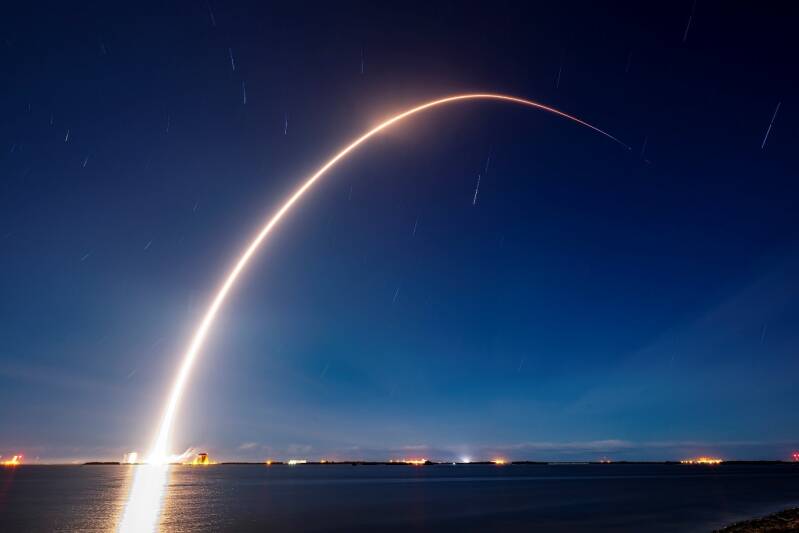
SpaceX launches the Starlink 6-101 mission from pad 40 at Cape Canaveral Credit: SpaceX
The Starlink 6-101 mission thundered away from Space Launch Complex 40 at 2:22 a.m. EST, carrying 29 new broadband satellites into low Earth orbit (LEO). This final push brings the total number of SpaceX satellites in orbit to over 9,500, according to data from astronomer and orbital tracker Dr. Jonathan McDowell.
Despite a slight concern regarding cloud cover, the 45th Weather Squadron reported near-perfect conditions (95% favorability). The mission utilized booster B1095, marking its fifth successful flight. Roughly 8.5 minutes after liftoff, the booster touched down on the drone ship Just Read the Instructions in the Atlantic Ocean—representing the vessel's 149th recovery and SpaceX's 566th successful booster landing to date.
Introducing Stargaze: The Future of Space Safety
While the launch was a feat of engineering, the bigger news arrived Thursday evening. SpaceX officially unveiled Stargaze, a software platform aimed at solving the increasingly dangerous "Wild West" nature of crowded orbits.
SpaceX noted that traditional ground-based tracking is often hampered by "volatile space weather" and limited observation windows, leading to dangerous uncertainties. In response, SpaceX is leveraging its massive constellation to act as a global sensor array.
"Stargaze delivers a several-order-of-magnitude increase in detection capability compared to conventional ground-based systems," the company stated.
How it works:
Massive Scale: The system utilizes data from 30,000 star trackers already mounted on Starlink satellites.
Continuous Monitoring: These trackers detect approximately 30 million transits of nearby objects daily.
Rapid Response: Stargaze can assess potential collisions in minutes, whereas current industry standards often take several hours.
A Close Call in Orbit
To illustrate the necessity of the tool, SpaceX revealed a harrowing incident from late 2025. A third-party satellite performed an uncoordinated maneuver that plummeted a safe 9,000-meter "miss distance" to a lethal 60 meters with just five hours to spare.
Because the third-party operator had not shared its trajectory, traditional systems were blind to the change. However, Stargaze detected the maneuver almost instantly. The system published a new trajectory and generated Collision Data Messages (CDMs), allowing the Starlink satellite to perform an avoidance maneuver within an hour and bring the collision risk back to zero.
SpaceX confirmed that Stargaze has been in a "closed beta" with over a dozen unnamed operators. In a move to improve global space situational awareness (SSA), the company announced the software will be available to all satellite operators free of charge via its space-traffic management platform in the coming weeks.
By sharing this high-fidelity data, SpaceX aims to mitigate risks posed by abandoned rocket bodies, uncoordinated satellite maneuvers, and the debris clouds generated by anti-satellite tests.
Add comment
Comments