

China is nearing operational readiness on its first offshore platform purpose-built to test, launch, and recover reusable liquid-propellant rockets, a move aimed at cutting launch costs and scaling up the country’s commercial access to orbit.
The new facility is located at the Oriental Aerospace Port in Haiyang, in eastern China’s Shandong province—currently the nation’s only dedicated commercial maritime launch base. Construction is now in its final stages on an artificial island roughly three kilometers off the Shandong coast, where more than 150 workers are completing structural installations, hoisting systems, and final integration work ahead of a targeted early-February start to trial operations.
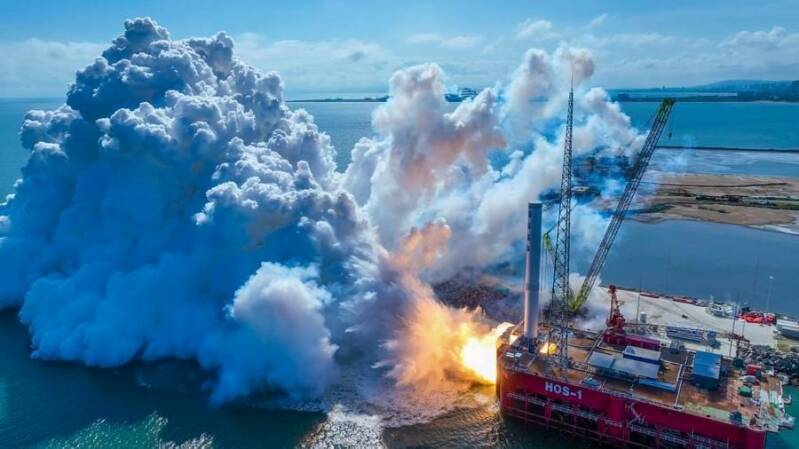
An aerial drone photo taken on Sept 15, 2025, shows a first-stage propulsion system test for the Tianlong-3 liquid carrier rocket conducted on an offshore launch pad at the Haiyang Oriental Aerospace Port in East China's Shandong province. Credit: Xinhua
According to a recent broadcast report, initial trial runs are expected to begin around February 5. These tests are intended to pave the way for the platform’s first maritime launch-and-recovery attempt of a commercial liquid-fueled rocket, tentatively scheduled to coincide with the Chinese New Year holiday period.
At the core of the offshore test complex is a launch stand equipped with a hydraulic erector system designed to handle rockets with liftoff masses reaching hundreds of tonnes. Four large hydraulic cylinders, installed in a deep underground pit, will raise launch vehicles from a horizontal transport position to vertical on the pad—an approach intended to simplify ground handling and support higher launch cadence.
Next to the launch stand is a flame trench extending 17 meters below the surface, engineered to channel exhaust plumes exceeding 3,000 degrees Celsius away from the pad during ignition and initial ascent. A surrounding water deluge system is designed to cool exhaust gases, reduce acoustic loads, and protect both launch infrastructure and payloads from intense thermal and vibrational stress during engine firing.
The Haiyang Oriental Aerospace Port already has substantial experience with offshore missions. To date, it has supported 22 successful sea launches that placed 137 satellites into orbit. However, all of those missions relied on solid-fuel rockets, which offer rapid deployment and mobility but are limited by expendable designs and comparatively lower payload capacity.
The new offshore platform is optimized for liquid-propellant launch vehicles capable of carrying heavier payloads and designed for recovery and reuse—capabilities viewed as essential for lowering the cost per kilogram to orbit and enabling large-scale deployment of satellite constellations. The artificial island is integrated into a broader launch-support zone that includes storage and handling infrastructure for liquid oxygen, liquid nitrogen, kerosene, and methane. These systems will support propellant loading, tank pressurization, and pipeline purging for upcoming generations of reusable liquid-fueled rockets.
Officials have described the offshore platform as a critical node in Shandong’s expanding aerospace industrial chain, which links launch services, rocket manufacturing, and satellite applications across cities such as Yantai, Jinan, and Qingdao.
At the national level, China has been moving to accelerate commercial space development. In November 2025, authorities released a three-year action plan covering 2025 to 2027 aimed at promoting high-quality, safe growth of the commercial space sector and integrating it more closely with broader space development strategies.
Data released by China National Space Administration show that the commercial segment of China’s space industry continued to expand in 2025. The country completed 50 launches during the year, with commercial missions accounting for 54 percent of the total. Of those, 25 flights were conducted by commercial launch vehicles. In total, 311 commercial satellites were delivered to orbit on Chinese rockets in 2025, representing 84 percent of all spacecraft launched by the country during the year.
Add comment
Comments