

Starfish Space is poised to make history after securing a $52.5 million contract from the U.S. Space Force to provide satellite deorbiting services—marking the first time the military has signed a deal specifically for end-of-life disposal within a low Earth orbit (LEO) constellation.
Under the agreement, the Washington-based company will use one of its Otter spacecraft to remove at least one satellite, and potentially several more, from the Proliferated Warfighter Space Architecture (PWSA). Starfish Space is targeting a 2027 launch for the Otter mission, which will demonstrate the ability to capture and safely deorbit satellites that were not originally designed for on-orbit servicing or docking.
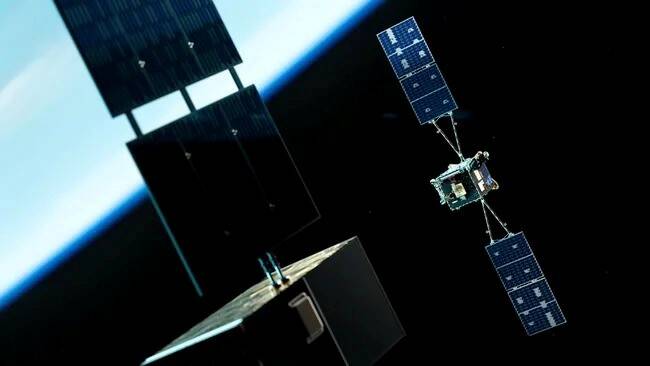
Starfish Space's Otter satellite is designed to rendezvous with and safely deorbit satellites without prior modifications, enabling disposal services for constellations in low Earth orbit. Credit: Starfish Space
real value to LEO constellation operators,” said Austin Link, co-founder of Starfish Space. He added that the company has “dramatically reduced the cost and complexity of satellite servicing across orbits,” positioning Otter as a practical solution for large satellite fleets.
The Space Force is in the midst of building out the PWSA, a sprawling network that will ultimately include hundreds of satellites supporting reconnaissance, navigation, and communications for U.S. military operations. The architecture represents a deliberate shift away from a small number of highly capable—and highly expensive—spacecraft toward a resilient, proliferated constellation that can better withstand potential hostile actions.
But the rapid growth of such constellations brings new challenges. Operators must balance the desire to extend each satellite’s operational life against the need to limit space debris by ensuring timely disposal. Starfish Space argues that its deorbit-as-a-service model offers a middle path, allowing operators to extract maximum value from their spacecraft while relying on Otter vehicles to remove satellites that can no longer safely deorbit themselves.
Although Otter has yet to conduct a full operational mission, the company has already demonstrated key elements of the technology in orbit. Its Otter Pup 1 pathfinder, launched in June 2023, maneuvered to within about one kilometer of a target spacecraft less than a year later. In October, an orbital transfer vehicle operated by Impulse Space used Starfish Space software to perform a close-proximity rendezvous in LEO. Meanwhile, Otter Pup 2, launched in June 2025, is expected to validate the first commercial satellite docking attempt in low Earth orbit.
The first operational Otter missions are slated to launch this year, giving Starfish Space hands-on experience before it undertakes its debut disposal mission for the Space Force—an effort that could help set a new standard for responsible satellite lifecycle management in an increasingly crowded orbital environment.
Add comment
Comments