

NASA has outlined its near-term roadmap toward the launch of Artemis 2, providing long-awaited clarity on rollout plans, testing milestones, and potential launch windows for the mission that will carry astronauts beyond Earth orbit for the first time in more than five decades.
In a statement released late Jan. 9, NASA said it plans to roll the Space Launch System rocket — topped with the Orion crew capsule — from the Vehicle Assembly Building to Launch Complex 39B no earlier than Jan. 17. The rollout, which remains subject to technical readiness and weather conditions, is expected to take about 12 hours.
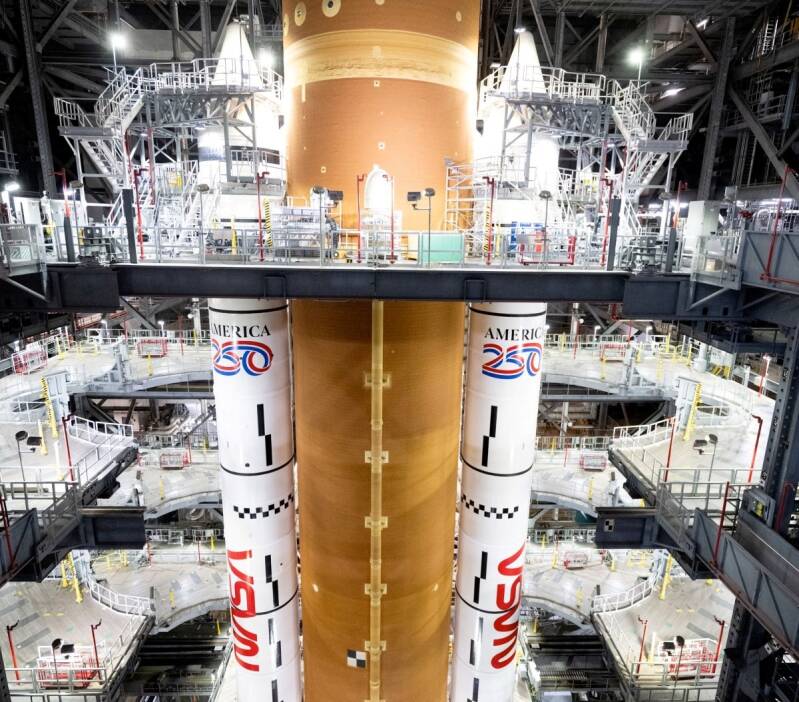
The Space Launch System rocket inside the Vehicle Assembly Building being prepared for Artemis 2. Credit: NASA/Joel Kowsky
Once the vehicle reaches the pad, teams will begin a series of integrated checks of both rocket and ground systems. Those activities will lead up to a critical wet dress rehearsal, the final major milestone before launch. During the rehearsal, the SLS rocket will be fully loaded with liquid oxygen and liquid hydrogen propellants while controllers run through a complete countdown sequence. NASA said the test is currently targeted for late January.
The agency’s cautious approach reflects hard-earned lessons from the Artemis 1 campaign in 2022. That uncrewed mission required multiple wet dress rehearsal attempts over nearly three months before completion, and hydrogen leaks during fueling later scrubbed the first two launch attempts. NASA said it has incorporated lessons learned from Artemis 1 into updated countdown procedures but emphasized that safety will dictate the pace.
“While NASA has integrated lessons learned from Artemis I into the launch countdown procedures, the agency will pause to address any issues during the test or at any other point should technical challenges arise,” the agency said. NASA added that it could conduct additional wet dress rehearsals or roll the vehicle back to the VAB if needed.
Although NASA did not specify how much schedule margin exists to absorb delays, it publicly detailed Artemis 2 launch periods for the first time. The first window includes late-evening launches (Eastern time) on Feb. 6, 7 and 8, as well as shortly after midnight on Feb. 10 and 11. A second launch period runs from March 6 to 11, followed by a third window from April 1 to 6.
The update follows weeks of limited public detail about Artemis 2 preparations, despite the mission’s historic importance as the first crewed flight beyond low Earth orbit since Apollo 17 in December 1972. As recently as Jan. 8, a NASA spokesperson told accredited media that there was still no confirmed rollout date.
NASA said recent work has focused on resolving several minor technical issues identified during a countdown demonstration test inside the VAB on Dec. 20. Those included a cable in the flight termination system that was bent out of specification, a valve replacement in Orion’s hatch pressurization system, and leaks in ground support equipment used to supply oxygen to the crew capsule.
“We have important steps remaining on our path to launch, and crew safety will remain our top priority at every turn as we near humanity’s return to the moon,” said Lori Glaze, NASA’s acting associate administrator for exploration systems development.
Another factor NASA continues to monitor is potential scheduling overlap with the Crew-12 mission to the International Space Station. Crew-12 had been slated for mid-February, after the first Artemis 2 launch window, but NASA said earlier this month it is evaluating options to move the mission earlier following the early return of Crew-11, which temporarily reduces the ISS crew complement.
NASA Administrator Jared Isaacman downplayed the likelihood of conflicts during a Jan. 8 briefing, saying the two missions would be managed as “totally separate campaigns.” However, NASA previously acknowledged operational sensitivities at Kennedy Space Center, noting in November that Crew-12 was shifted earlier specifically to avoid potential conflicts with Artemis 2 as both missions draw on shared facilities and resources.
Add comment
Comments