

Rocket Lab’s bid to close out 2025 with a rapid-fire trio of Electron launches hit a brief pause early Monday, after the company aborted one of its missions moments before liftoff when onboard systems detected an anomaly.
In an update issued at 1:26 a.m. EST (0626 UTC) on Dec. 16, Rocket Lab said the launch attempt late Dec. 15/early Dec. 16 was halted after “one of Electron’s thousands of sensors noticed out-of-family data and called time on lift-off, exactly as it was designed to do.” The company described the issue as a straightforward fix and said teams are working to resolve it before selecting a new launch date.
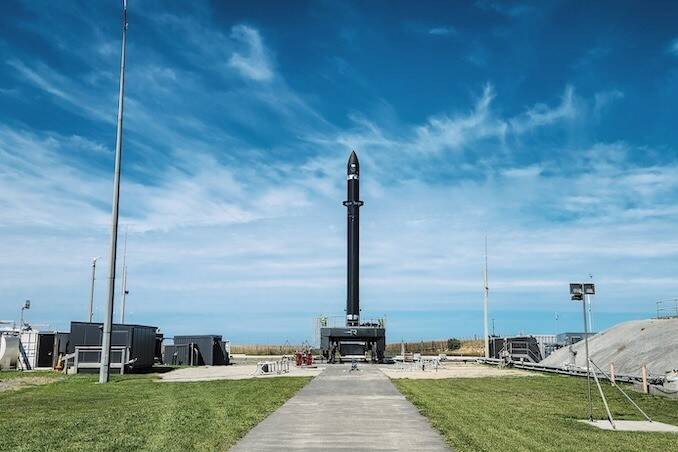
Rocket Lab Electron rocket stands at Launch Complex 1 ahead of the flight of the ‘Bridging the Swarm’ mission for the Korea Advanced Institute of Science and Technology (KAIST). Image: Rocket Lab
The scrub came amid what has already been a historic stretch for Rocket Lab, as the company works toward its fastest-ever sequence of Electron missions across three launch pads in New Zealand and the United States.
The surge in activity began with the successful “RAISE and Shine” mission for the Japan Aerospace Exploration Agency (JAXA), which lifted off at 0309 UTC on Dec. 14. That flight placed a JAXA satellite into orbit and marked Rocket Lab’s 19th Electron launch of the year.
Less than 48 hours later, Rocket Lab targeted its next mission, “Bridging the Swarm,” from New Zealand. The launch, originally scheduled for Dec. 11, is intended to deploy the Neonsat-1A satellite for South Korea’s Satellite Technology Research Center (SaTReC) at the Korea Advanced Institute of Science and Technology (KAIST). Neonsat-1A is an advanced Earth-observation spacecraft equipped with a high-resolution optical camera designed to monitor natural disasters across the Korean Peninsula.
Rocket Lab has previously launched Neonsat-1 during the April 2024 mission “Beginning of the Swarm,” which the company says has been successfully performing its Earth-monitoring role. The Neonsat-1A mission is intended to validate upgraded satellite capabilities and support the transition toward a future Neonsat constellation, with additional satellites planned for launch in 2026 and 2027. When it flies, Neonsat-1A is slated for a 540-kilometer, sun-synchronous orbit at a 97.4-degree inclination, with deployment from Electron’s Curie kick stage expected about 54 minutes after liftoff.
Rocket Lab’s December launch cadence is set to continue later in the week with a mission from the United States. On Dec. 19, the company is scheduled to launch an Electron rocket from Launch Complex 2 at NASA’s Wallops Flight Facility in Virginia during a window opening at midnight EST (0500 UTC). Known as “Avalanche,” the mission has not been formally detailed by Rocket Lab but is widely believed to be Space Test Program STP-S-30 for the U.S. Space Force’s Space Systems Command. The payload, DiskSat, is designed to demonstrate sustained operations in very low Earth orbit below 350 kilometers.
DiskSat will test a one-meter-diameter, disk-shaped satellite bus engineered to reduce atmospheric drag by adjusting its orientation in flight. According to the Aerospace Corporation, which leads the project, the goal is to combine the satellite’s shape with electric propulsion to maintain extended operations in a region of space that offers unique advantages for Earth observation but presents significant technical challenges.
The company’s strong finish to the year builds on what has already become a record-breaking period for Electron. Rocket Lab has flown 19 Electron missions in 2025, including 16 orbital launches and three suborbital flights under its Hypersonic Accelerator Suborbital Test Electron (HASTE) program. That total surpasses previous annual records and reflects a steady increase in launch cadence over the past several years.
Rocket Lab founder and CEO Sir Peter Beck has credited the pace to deliberate design and manufacturing choices aimed at high-volume operations. Speaking during a November earnings call, Beck said Electron was built with scalability in mind, extending beyond the rocket itself to production lines, processing facilities, and launch infrastructure. He added that the same philosophy is being applied to the company’s larger Neutron rocket.
Neutron’s debut flight, originally expected in 2025, has slipped into early 2026, with the first launch now targeted for the first quarter or shortly thereafter. Beck has emphasized that the inaugural mission will focus on reaching orbit rather than carrying a customer payload, with extensive ground testing intended to minimize surprises during flight.
Looking ahead to 2026, Rocket Lab has not disclosed a target number of Electron launches, though its factory is designed to produce up to 52 rockets per year. One of the missions slated for early next year is NASA’s Aspera spacecraft, awarded to Rocket Lab under the agency’s VADR contract. Aspera will study ultraviolet light from the intergalactic medium, helping scientists better understand how gas flows into and out of galaxies and contributes to star formation.
Add comment
Comments