

Rocket Lab is preparing to expand its role in the global launch market, announcing the successful completion of final qualification tests for the innovative fairing that will top its upcoming Neutron rocket. The partially reusable launch vehicle, built to challenge SpaceX’s Falcon 9 in medium-lift missions, is slated to make its debut flight early next year.
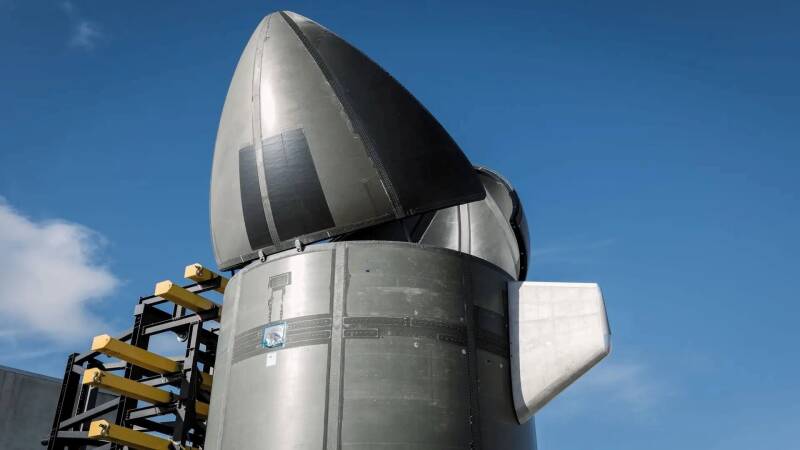
The Neutron launch vehicle's innovative "Hungry Hippo" captive fairing. Credit: Rocket Lab
The Neutron’s standout feature is its unconventional “Hungry Hippo” fairing—a clamshell-like design that opens and closes in one piece, resembling the snapping mouths of the classic children’s game. Unlike traditional rockets, whose fairing halves separate and fall away during ascent, Neutron’s first stage will open its massive fairing to release the second stage and payload, then reseal itself before returning to Earth for recovery.
Rocket Lab’s current small-launch workhorse, Electron, is expendable, but Neutron marks the company’s push into reusable, higher-capacity launch vehicles. SpaceX’s Falcon 9 remains the only operational orbital rocket with a flight-proven reuse system, making Neutron’s architecture a bold attempt to introduce new competition into the market.
Following completion of qualification tests, the fairing has been transported from Rocket Lab’s California test site to the Mid-Atlantic Regional Spaceport at Wallops Island, Virginia, where it will be integrated with the rest of the rocket ahead of the inaugural mission.
“A rocket like Neutron has never been built before, and we’re doing it at a pace and price point that’s going to bring the innovation and competition needed in today’s industry,” said Shaun D’Mello, Rocket Lab’s Vice President for Neutron, in a Dec. 8 announcement.
Rocket Lab describes Neutron as “the world’s largest carbon composite launch vehicle,” a claim underscored by the extensive test campaign its fairing endured. Engineers subjected the structure to 275,000 pounds of external force to simulate launch stresses, repeatedly cycled its opening mechanisms far beyond operational requirements, verified the fairing’s software integration, and pushed load forces to more than 125% of its design limits.
Next steps include a series of major prelaunch checkouts once the fairing is attached to Neutron’s reusable first stage. These tests will culminate in a static fire of the rocket’s nine Archimedes engines.
Standing 141 feet (43 meters) tall and measuring 23 feet (7 meters) in diameter, Neutron is designed to deliver up to 28,700 pounds (13,000 kilograms) to low Earth orbit—positioning Rocket Lab as a formidable new competitor in the rapidly evolving commercial launch landscape.
Add comment
Comments