

In a landmark decision that signals Europe’s ambition to strengthen its foothold in space, the European Space Agency (ESA) on Thursday announced it has secured a record €22.1 billion budget to fund its programs over the next three years. The agreement was reached during a pivotal ministerial council meeting held in Bremen, underscoring the continent’s intensified push for technological independence and enhanced space security.
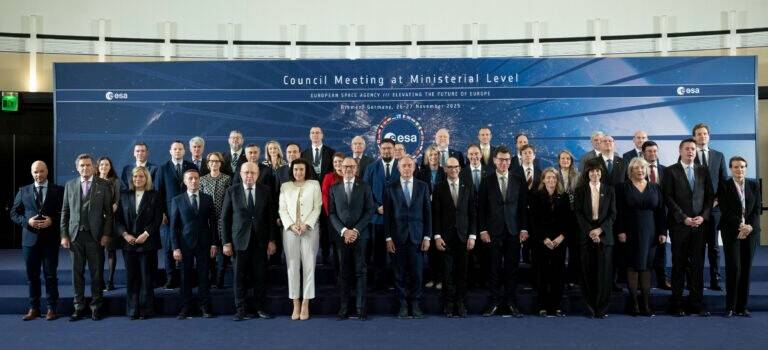
Ministerial representatives of ESA’s 23 Member States, Associate Members, Cooperating States, and associated organizations met in Bremen, Germany from November 26-27, 2025 for the 2025 Council of Ministers meeting, CM25. Photo credit: ESA.
The newly approved budget is €5 billion higher than ESA’s 2022 allocation, reflecting a sweeping show of support from its 23 member states. The funding nearly matches the €22.2 billion initially requested by the agency—an unprecedented outcome that ESA Director General Josef Aschbacher said demonstrates remarkable confidence in the organization's direction.
“This has never happened before,” Aschbacher told ministers gathered in Bremen. He later emphasized in an interview that the commitment from member nations “speaks volumes” about the trust placed in ESA’s long-term strategy and its expanding role in both civilian and security-focused space activities.
A central focus of the ministerial discussions was the European Resilience from Space initiative, an expansive program aimed at reducing Europe’s reliance on foreign space infrastructure. The effort encompasses advancements in Earth observation, satellite-based services, next-generation communications, and autonomous launch capabilities—areas where Europe seeks to close the gap with global competitors like the United States and China.
The meeting also marked a shift toward deeper defence cooperation in space, reflecting the growing recognition that orbital assets are critical to national security, crisis response, and technological sovereignty. ESA unveiled plans to work more closely with European defence institutions, while still maintaining its civil space mandate, to strengthen protection against threats such as orbital debris, jamming, and hostile actions in space.
Member states also endorsed a suite of upcoming scientific missions, designed to expand Europe’s leadership in space research. These include projects in planetary exploration, astrophysics, and climate science—fields where ESA has historically delivered globally recognized achievements.
The record-setting budget positions ESA for an era of accelerated development, as Europe works to maintain competitiveness amid a rapidly evolving global space landscape. With investments spanning commercial, defence, scientific, and environmental domains, the continent is making one of its strongest statements yet on the importance of space to its future security and prosperity.
The decisions made in Bremen are expected to shape European space efforts well into the next decade, cementing a strategic vision where Europe stands not just as a participant, but as a major autonomous force in space.
Add comment
Comments